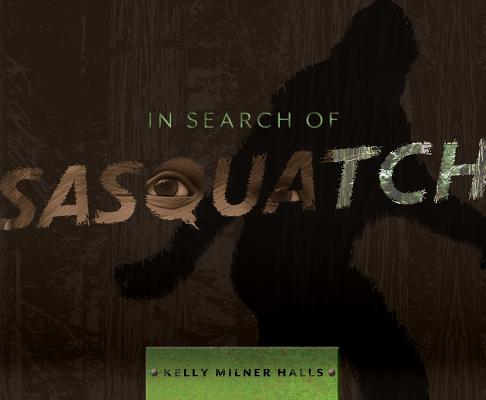
A few weeks ago, I posted this review of Kelly Milner Halls’ most recent book, IN SEARCH OF SASQUATCH. Kelly was kind enough to follow up that review with an incredible interview about the book and her writing career. Please help me welcome author Kelly Milner Halls!
LT: Hi Kelly, and thank for coming! I guess I have to start with the obvious, though I’m fairly confident I know the answer from reading the book: Do you believe in Sasquatch?
KMH: I do not believe, 100%, that Sasquatch is real. I tend to be skeptical by nature—the journalist in me. But I believe there are some very convincing bits of evidence that suggest SOMETHING is out there—an animal we haven’t yet defined and don’t really understand. Too many reliable people have witnessed too many amazing things to ignore them.
LT: What was/were the hardest things about researching and/or writing this book? How did you deal with that?
KMH: I wanted to be sure my witnesses and experts were serious people, not people who wanted fame or glory. There is nothing wrong with fame or glory, but I wanted people who were fact-centered, so that required some hard work. I think I found good interview subjects to meet that standard. Hope so.
LT: During your research, did anything surprise you, catch you off guard, or make you change your planned course for the book?
KMH: The fact that Scott Nelson believes Sasquatch may have its own language absolutely blew my socks off. His reasoning is so clear and logical, it almost make my head explode. If that’s true, that’s a reason to protect the “maybe” primate.
LT: Did you do all the photo research for the book too? Can you tell us about that process?
KMH: I took a number of the photos, but a wonderful Sasquatch investigator named Paul Graves from Yakima, WA, was extremely generous about sharing his field photographs for the book. He is also a musician who writes Sasquatch songs, and he’s featured in the book. But he was very generous, and I’m grateful.
LT: How do you manage all of your research for a book like this? What’s your organizational system? Does it evolve over the course of a project?
KMH: I keep elaborate, well-backed up computer files about each subject, each topic, each chapter, so I can find my notes with ease. And there are so many notes. I read a dozen books, did more than two dozen interviews and collected dozens of images for this book. It was hard but amazing work. It’s what I love to do.
LT: How have your research and writing processes evolved over the course of your career?
KMH: As my children have grown into adulthood, I have been able to travel more to get my information first-hand, rather than on the telephone. Having both field and phone time really adds richness to the books I write and the presentations I give.
LT: How much time did you spend researching this particular book overall, and how long did it take to write the book? Is that typical?
KMH: Most of my books take between three and five years to research, then another year to write. I don’t like to rehash material that already exists. I like to present new information whenever possible and that takes time and effort.
LT: How do you know when a book is “done” and ready to send to your agent or editor?
KMH: The book isn’t even close to done when I send it to my editors or agent. It’s a proposal. It maps out how I see the book once it’s complete and gives us all a place to start. But the book evolves considerably as we work together as a time. I’m selling a concept that will change and improve as we all work on it, and that’s the magic of the editorial process.
LT: Are there any other tips you would like to share with aspiring children’s book writers, especially those writing nonfiction for kids?
KMH: Watch for the topics that YOU find most engaging and consider offering them up to young readers. Your excitement, your sense of wonder will show through every word you write and the kids will feel the human connection. If you are not excited about your topic, that lack of enthusiasm will be just as clear to the young readers. So write about things the excite you. You’ll give the kids a reason to be excited, too.
LT: I think every book teaches us something new, about the world, about ourselves, or about the craft of writing. What have you learned as a result of writing this book? What surprised you the most during the process?
KMH: I have learned that we forget our humanity when it comes to animals at times. But we can also renew it. The more you know about even an unknown creature, the harder it is to simply disregard or disrespect it. It’s like my pet chickens. I can eat grilled chicken without a blink of an eye. I love chicken dinner. But I could never even consider eating my pet chickens. You work harder not to hurt the things you understand well. Knowledge, exploration, is the key to more love, less hate. That is confirmed every time I write a book and share it with kids.
LT: I’ve always said that I will know I’ve made it when I receive one letter from one child saying that something I wrote made a positive difference in his or her life. How do you define success? Do you feel like you’ve achieved it? If not, what’s left on your to-do list?
KMH: I used to yearn for the day when I’d win a major nonfiction book award. Years went by, and it didn’t happen. Then I started meeting kids—many of them boys, but girls too—who loved my books, kids who said I was their favorite author. I started hearing stories about kids who clung to my books like life jackets—kids who drew comfort from MY books, award-winning or not. After that starts to happen regularly, you realize awards are lovely, but the real measure of success are those readers and their ability to feel a little less alone because of something you’ve given them. That’s how I measure success. If I have made your child’s life a little kinder, a little safer, I am the luckiest writer on earth.
LT: What do you like to do when you’re not researching and/or writing?
KMH: I am always writing, so that’s a hard question. I do a LOT of school visits, which I love. I paint, I meet with friends, I work for my friend Chris Crutcher, I walk my dog and take care of my lizard. I sleep now and then, when time permits. : ) Life is crazy busy, but good.
LT: What are you working on now?
KMH: I’m finishing a book on animal rescues for National Geographic called TIGER IN TROUBLE. I’m putting together another YA anthology for Chronicle Books—just got that news yesterday. I am researching the history of video games for a new book project. And I’m going to write a book on ghosts for Millbrook. I have two other proposals under consideration at Houghton Mifflin Harcourt, too, but they aren’t firm yet, so I better not talk about them.
LT: What would you most like people to know about you?
KMH: That I don’t have a mean bone in my body, that I live to make life a little easier and kinder for the people I meet. I’d like them to know that I am exactly who I say I am, with no need for deceit or animus. Life is too short for cruelty and anger. Like the Beatles said, all we REALLY need is love. I hope my humanity shows, even in my quirky works of nonfiction for kids. Kids need love, most of all.
LT: Well, Kelly, I have LOVED interviewing you! Thank you so much for so generously sharing your expertise and heart with us, in your books as well as on this blog.
Stay tuned for an upcoming review of Kelly’s new book, ALIEN INVESTIGATION, coming from Lerner Publishing on April 1, 2012 (no fooling!).
Laurie Thompson
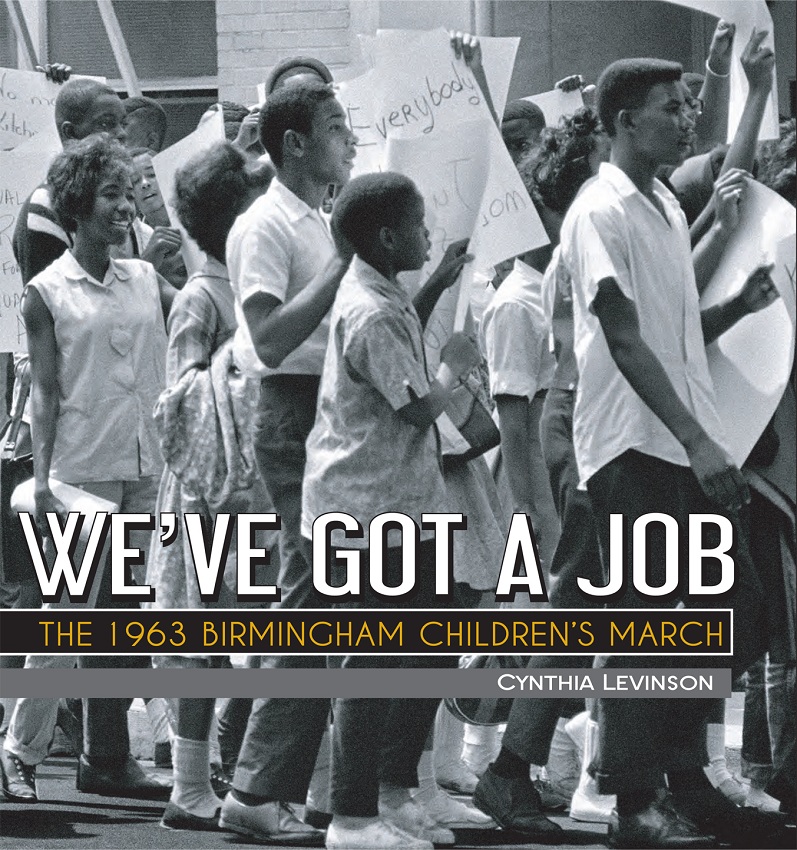
Review: We’ve Got a Job

We’ve Got a Job
by Cynthia Levinson
Peachtree Publishers, February 1, 2012
176 pages
Ages: 10 and up
Oscar Wilde supposedly said, “Any fool can make history, but it takes genius to write it.” While I don’t necessarily agree with the first part, the second part absolutely rings true. After all, how do you make a story compelling when everyone already knows how it ends? Cynthia Levinson has proven her genius here, because she accomplishes that and so much more in WE’VE GOT A JOB.
By anchoring the events surrounding the 1963 Birmingham Children’s March in the personal narratives of four of its direct participants, Levinson puts readers on the ground in Birmingham. We may know the final outcome, but we have no idea how we’re ever going to get there, and this day-by-day account of the incremental progress—and setbacks—will keep readers turning the pages to find out what happened next. This is a nonfiction book with as much drama and pacing as THE HUNGER GAMES. I literally couldn’t put it down, except for when I became too teary-eyed to continue reading, which happened often.
There is so much to love about this book, but I think my favorite thing about it is how Levinson humanizes everyone involved. It’s not as much a movement or an event as it is individuals, each with his or her own motivations, working with or against each other. I loved reading that even the revered leaders (for both sides of the issue) were hardly ever in agreement. Everyone involved was taking a chance, a risk, a guess as to what was going to work—or not. They were all fighting for what they believed in, each in his or her own unique way. Nothing was simple. Nothing was clear.
I wholeheartedly think this book should be in every library, in every classroom, and in every home in America for its history as well as for its message for the future. Buy it, read it, recommend it, share it.
The book also includes a table of contents, author’s note, timeline, map, acknowledgements, extensive source notes, bibliography (recommended resources), photo credits, and a detailed index. Levinson also has additional info, lesson plans, discussion questions, curriculum guides, and more on her website.

To check out the rest of today’s roundup of nonfiction books for kids, head on over to this week’s Nonfiction Monday host, Wendie’s Wanderings!
(Disclaimer: I received an advance reader copy (ARC) of this book from Peachtree Publishers in exchange for my honest review, and it was so good I pre-ordered my own published hardcover. I received no monetary compensation. All opinions expressed here are mine and mine alone.)
STEM Friday roundup is here!

I’m thrilled to be hosting STEM Friday today! If you reviewed a STEM (Science, Technology, Engineering, and Mathematics) book for kids on your blog today, please leave your link in the comments or on Twitter (@lauriethompson), and I will add you to the round-up throughout the day. Thanks!
My contribution to this week’s STEM Friday, a review of IN SEARCH OF SASQUATCH by Kelly Milner Halls, is posted here.
Jeff Barger reviews A Leaf Can Be… by Laura Purdie Salas over at NC Teacher Stuff. Read all about this poetry book about leaves here.
Roberta at Wrapped in Foil brings us You Just Can’t Help It! Your Guide to the Wild and Wacky World of Human Behavior by Jeff Szpirglas.
Over at Archimedes Notebook, Sue Heavenrich reviews Star of the Sea by Janet Halfmann, with some insight on writing from the author herself.
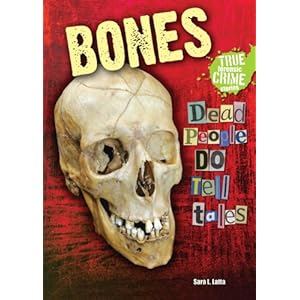
Anastasia Suen from Booktalking joins the fun with her review of Bones: Dead People Do Tell Talesby Sara L. Latta.
Next week’s STEM Friday host will be Roberta Gibson at Wrapped in Foil.
Review: In Search of Sasquatch

In Search of Sasquatch
by Kelly Milner Halls
Houghton Mifflin Books for Children (October 25, 1011)
64 pages, ages 9 and up
When I was a kid, one of my favorite books was BIGFOOT: MAN, MONSTER, OR MYTH? by Carrie Carmichael (Raintree, 1977). I’ve always been an animal lover, and I loved the possibility that there was one (or more?) out there clever enough to remain a mystery to us. I lived in rural northern Wisconsin and spent a lot of time in the woods, but, sadly, never saw any Sasquatch signs.
When my son told me he thought it’d be cool to be a cryptozoologist (nice!), I knew I had to get him this book. It didn’t disappoint. He’s read it several times cover to cover, and I’m loving the facts and critical thinking skills he’s demonstrating as a result.
My first thought when I opened the book was how beautiful it is. The full-bleed forest spread with the quotes overlaying the trees pulls you right into the world of the sasquatch from the very first page turn (and the final one, as well). The beauty continues with beautiful photography, elegant illustrations, and well-done layout and design throughout.
Halls combines various myths and legends with expert opinions and eyewitness accounts to weave a cleverly crafted and compelling case for the existence of sasquatch. She doesn’t come right out and tell us that it does or doesn’t exist, though. In the end, it’s up to the reader to decide if they’ve been convinced or not.
This is a great book to hand to any kid with an interest in cryptids or other mysteries, and animal lovers and budding young scientists will also enjoy it.
FUN FACT: “According to experts at the Bigfoot Field Researchers Organization (BFRO), credible witnesses have reported seeing Sasquatch in every state in the United States of America except Hawaii, as well as most Canadian provinces.”
There is a dedication, table of contents, additional resources, photo and illustration credits, bibliography and source notes, glossary, and index.
SIDE NOTE: When asked her opinion of the book, my daughter answered, “I LOVED how she crammed so many facts into this book, yet still kept it completely interesting!” My answer: “Ahem. <cough> ‘YET STILL?’ Have I told you what I do? FACTS ARE INTERESTING!” I have failed as a parent.
This is my review for STEM Friday, which I’m also hosting this week! See the complete roundup here.
Disclaimer: A copy of this book was checked out from my local library for review. Thanks, King County Library System!
Read more kids’ nonfiction in 2012!
Still trying to come up with some resolutions for the new year? Or would you prefer having one or two that are more pleasure than pain? Well, in the spirit of

…I’ve got just the thing for you!
Read more nonfiction for kids!
There are two challenges out there right now to help you do just that… and share the fruits of your labor with like-minded peeps around the world.
First, Kid Lit Frenzy and The Nonfiction Detecetives have teamed up to offer the The Nonfiction Picture Book Challenge 2012. Their goal is to encourage everyone to read more nonfiction picture books this year. All you have to do is set a goal for yourself (like reading one nonfiction picture book each week or each month). You can visit both the Kid Lit Frenzy and The Nonfiction Detecetives blogs throughout the year for nonfiction reviews and giveaways, tweet about the challenge using the hashtag #nfpb2012, and add the Non-Fiction Picture Book badge to your web site.
Second, Ms. Houghton’s Class challenges us to read the Sibert Medal winners and honorees here. This has been on my to-do list for awhile, so thank you Ms. Houghton for giving me that extra push. I’m in! She has the complete list in her post, OR you can find the official list of past winners here and current winners here. New winners for 2012 will be announced 1/23/2012 (search for #alayma on Twitter). You can also keep track of this challenge on Twitter by searching for #nerdibert.
I’m doing both, along with my other New Year’s Resolutions, which are to read more adult nonfiction and keep better track of all of these books in a reading log. I hope you’ll join me!
UPDATE: I made a Google docs spreadsheet with all the info for the Sibert books. Feel free to download it from here and use it to track your progress!
What I Learned From the Cybils

The Cybils’ Nonfiction Picture Book panel for round one, which I was thrilled to be a part of this year, recently finished our deliberations.
The panelists were:
- Fiona Bayrock (blogging at Books and ‘Rocks)
- Janssen Bradshaw (blogging at Everyday Reading)
- Susan Murray (blogging at From Tots to Teens)
- Cathy Potter (blogging at The Nonfiction Detectives)
- Jennifer Wharton (blogging at Jean Little Library)
- Paula Willey (blogging at Pink Me)
- and me!
There were 87 nonfiction picture books to read. Of those, 23 ended up on my “possible contenders” list, and only four of those ended up on my “absolutely must fight for” list. The seven of us had to ultimately agree on seven (or fewer) titles to send on to the round two judges. (And, I’m happy to report, we did it! But you’ll have to wait a few more days to find out what we chose.)
What a thought-provoking and educational experience this was to go through, as both a writer and as a reader. These smart, savvy, and opinionated book-loving women validated many of my own feelings about nonfiction for kids, and brought to light some nuances that I hadn’t really thought about before, and the whole process really made me think about the titles that I loved through both lenses of the Cybils criteria: literary merit AND kid appeal. It wasn’t enough to have one or the other (which many titles did). Our job was to identify at most seven titles we felt were the best of both worlds. A few titles were easy shoe-ins: we agreed on those right away. The remaining spots were only filled after great debate, with some arguing for and other against. The reasons not to include something on the short list were often even more enlightening than the reasons to include something.
Major reasons why otherwise deserving titles got passed over:
- Insufficient back matter. Back matter can really make or break a nonfiction book, even a picture book for the youngest
readers. If we, the adults, don’t trust you, the author, we’re not going to put that book into a kid’s hands. Authors and publishers: it’s worth budgeting the space for those extra pages at the back. Consider it your chance to show off your hard work and prove your expertise, as well as to share your passion with your readers, adults and children alike. Sadly, I think insufficient back matter hurt both literary merit and kid appeal on many otherwise wonderful titles. - Art and design. Not being an artist myself, I was surprised how divisive this area could be. Sometimes we loved the art, but didn’t feel the words were up to par. Sometimes we loved the text, but rejected the art. Sometimes we even loved both, just not together! And often, we had conflicting opinions across the panel. Sometimes the layout and design added to the other elements, sometimes it took so much away as to knock a title out of the running altogether. As an author, I’ll have no control over this (gulp!), but it makes me even more aware of how important it is to find an editor and a publishing house that I can trust to get it all right.
- Age appropriateness. There were subjects that seemed either too young or too old for the audiences they were written for, either too dumbed down or too sophisticated to be appealing to the intended readers. It’s tough to strike that balance of reading level, interest level, and relevancy, but as an author (and illustrator), you just have to do it. I’ll be holding up my own manuscripts to much greater scrutiny in this area.
I want to thank each and every one of the panelists for a thoroughly enjoyable and eye-opening decision-making process. I hope the round two judges are pleased with our choices and look forward to their choice for the winner. I don’t envy their job one bit!
Review: Bring On the Birds
Bring On the Birds
written and illustrated by Susan Stockdale
Peachtree Publishers (February 1, 2011)
32 pages, ages 4 and up
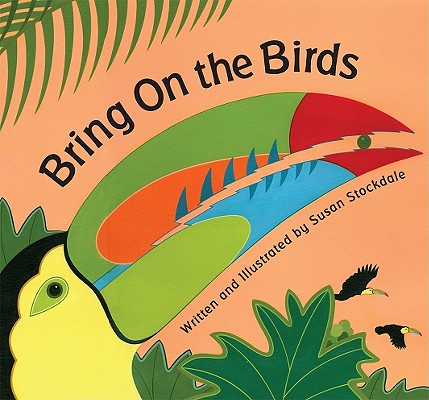
This is one of my favorite books of all the nominations in the Cybils Nonfiction Picture Book category this year, and I just can’t get over how absolutely perfect it is. The poetic text is a simple but elegant rhyme with spot on rhythm and meter:
“Swooping birds,
whooping birds,
birds with puffy chests.
Dancing birds,
diving birds,
birds with fluffy crests.”
The illustrations are bright, clean, and not only depict the various birds, but also place them in their appropriate habitats.
The 21 birds featured run the gamut from the common robin to the more exotic blue-footed booby, from the great blue heron to the blue bird-of-paradise. This book covers an enormous diversity of life, then ends just right with what they all have in common:
“All of them have feathers,
and all are hatched from eggs.”
This is a wonderful introduction to birds for the youngest readers. It could also be used to talk about diversity, habitats, and classification.
At the end of the book, Stockdale includes a perfectly brief and spot-on paragraph with information about each bird profiled in the book. The book also includes a bibliography.

To check out the rest of today’s roundup of books for kids about topics in science, technology, engineering, and mathematics, head on over to this week’s STEM Friday roundup over at Anastasia Suen’s Booktalking.
(Disclaimer: I received a copy of this book from my local library. I received no monetary compensation for this review. All opinions expressed here are mine and mine alone.)
Review: Amazing Kitchen Chemistry

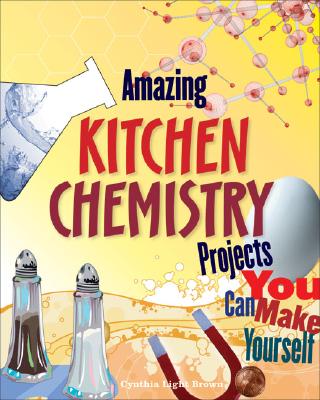
Amazing Kitchen Chemistry Projects You Can Make Yourself
by Cynthia Light Brown (Author)
Nomad Press (May 1, 2008)
122 pages
Ages: 9–12
From the publisher’s web page:
“In Amazing Kitchen Chemistry Projects You Can Build Yourself, kids ages 9 and up will experiment with kitchen materials to discover chemistry. Readers will learn about atoms, molecules, solids, liquids, gases, polymers, the periodic table, the important history of science, and much more. Along the way, they’ll make goop, cause chemical reactions, and create delicious treats, and all of it will illustrate important chemistry concepts. Amazing Kitchen Chemistry Projects is a fun and exciting way for young readers to learn all about chemistry and become scientists right in the kitchen.”
My son has always loved science, so we’ve gone through many books like this over the years. As a parent, I have to say this is my favorite one so far. Why? First, all the supplies and ingredients are already in my house or readily available. Yay! He can pick a project and we can DO it, rather than make a shopping list and get back to it when I’ve collected all the hard-to-find necessities. Second, the science concepts behind the projects and any specialized vocabulary words are explained in a clear, accessible way. Finally, the projects themselves as well as the layout, fun facts, sidebars, and illustrations, are just plain FUN!
Topics include atoms and molecules, mixtures, reactions, acids and bases, solids, liquids, gases, state changes, polymers, and water. Some of things you can make are a buckyball, a chroma-color bookmark, an Alka-Seltzer rocket, invisible messages, crystals, rock candy, a wave tank, a Mentos explosion, taffy, ice cream, oobleck, meringue cookies, paper, bubble solution, and more!
I think this is a book that young scientists, as well as their parents and teachers, will appreciate.
In the interests of “keeping it real,” though, I have to share my son’s one and only complaint: “It’s not even in color!” With so much great stuff happening on every page, I honestly hadn’t even noticed. He’s very visual, so it was a big drawback for him. I don’t know if other kids would be as sensitive, and I’m sure most adults will appreciate the cost savings.
This book also includes a table of contents, an introduction, a glossary, recommended resources, and index.
FAVORITE FUN FACT: On page 18, I learned that Alfred Hitchcock’s The Birds was based on a real event! In 1961, birds started crashing into houses in the middle of the night in a coastal California town. People went out with flashlights to investigate, and the birds flew toward the lights and pecked at the people, who ran back inside for cover. The next day, they found the streets full of dead and confused birds. 26 years later, scientists finally discovered it was caused by a neurotoxin that can build up in sea creatures that eat a dangerous type of phytoplankton, and the birds–or people–that in turn eat those sea creatures! Who knew?
To check out the rest of today’s roundup of books for kids about topics in science, technology, engineering, and mathematics, head on over to this week’s STEM Friday host, Wrapped in Foil!

(Disclaimer: I received this copy for free directly from the publisher for review.)
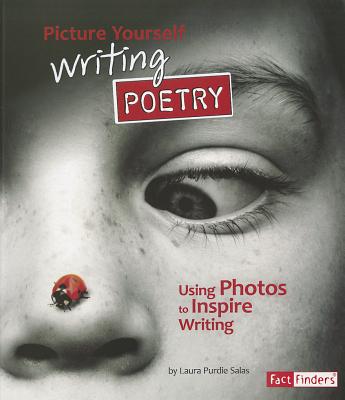
Review: Picture Yourself Writing Poetry
Picture Yourself Writing Poetry: Using Photos to Inspire Writing
by Laura Purdie Salas
Capstone Press, August 2011
32 pages
Ages: 8 and up
This title is one of the Picture Yourself Writing ____: Using Photos to Inspire Writing series, and it’s quite effective—it inspired me to write! Not only does it demonstrate how one can use images to get ideas for poems, it also contains many specific, easy-to-understand writing tips. Salas covers such important topics as incorporating sensory detail, choosing concrete nouns and strong verbs, characterization and point of view, and structure, all paired with wonderful examples.
The books opens up with the line, “The best poems are magical, miniature worlds.” It then shows readers how to create those worlds themselves while inviting them to enter several created by Salas.
I think this would be a great book to incorporate into any poetry curriculum. I would also heartily recommend it to students who enjoy writing… as well as to those who tend to struggle with it.

(Disclaimers: I received this copy for review for free from the publisher as part of the Cybils judging process. This review is my opinion only and doesn’t necessarily reflect the judging committee’s selections.)
The importance of play
I have a confession to make. I’ve never been much of a journaler, my creativity has always been bursty, and I have never in my life had anything resembling a daily writing habit.
But I really need one.
“Need” is the right word, too. I almost wrote “should,” but that isn’t quite correct. It’s 1:30 p.m., and I’ve accomplished next to nothing so far today. I’ve been procrastinating, surfing, organizing, cleaning… but not one thing that actually gets me closer to my goals. I have a whole bunch of things I “should” be doing, revisions and research. That’s not the problem. The problem is more that I’m in a sort of funk, and none of those “should” tasks appeal to me right now. This slump I’m in, I think is because I’ve lost contact with my creative self. I’ve let the inner editor have too much to do, too much to say lately. Yes, I’ve needed it for the revisions I’ve been working on, but it got too much practice, while my creative side withered.
I haven’t written anything brand new, aside from a few blog posts here, for almost six months. Blog posts are good, I guess. I get to create, write, practice–and it serves a useful purpose, too (I hope!). A nice win-win.
But, writing something for public consumption is not the same as freewriting, practice, PLAY. I’ve been reading HOW TO BE A WRITER by Barbara Baig and the first thing she addresses is this need to free ourselves from expectation and play with writing, without fear of anyone else seeing the results. I’ve been seeing this advice show up in various snippets here and there from various wise people for the past few weeks. The universe is sending me signals, but I’ve been trying hard to overlook them to focus instead on the “should“s, the concrete to-do list, the goal-oriented approach to achieving my dreams.
I’m a logical person. I write nonfiction. I make lists. I set goals, and break them down, and work towards them. This is all good and useful… to a point.
But sometimes, the well runs dry. I need to rest. I need to read. I NEED to create. That, after all, is the end goal. So, it’s time to listen to the universe.
You, dear revisions, will just have to wait. I’m currently busy with much less important things.