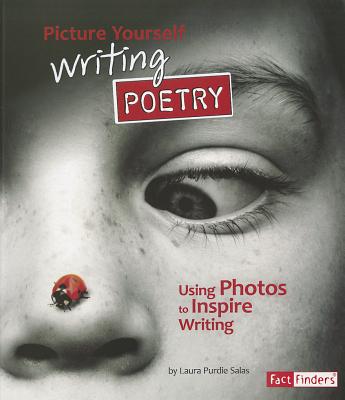
Picture Yourself Writing Poetry: Using Photos to Inspire Writing
by Laura Purdie Salas
Capstone Press, August 2011
32 pages
Ages: 8 and up
This title is one of the Picture Yourself Writing ____: Using Photos to Inspire Writing series, and it’s quite effective—it inspired me to write! Not only does it demonstrate how one can use images to get ideas for poems, it also contains many specific, easy-to-understand writing tips. Salas covers such important topics as incorporating sensory detail, choosing concrete nouns and strong verbs, characterization and point of view, and structure, all paired with wonderful examples.
The books opens up with the line, “The best poems are magical, miniature worlds.” It then shows readers how to create those worlds themselves while inviting them to enter several created by Salas.
I think this would be a great book to incorporate into any poetry curriculum. I would also heartily recommend it to students who enjoy writing… as well as to those who tend to struggle with it.
(Disclaimers: I received this copy for review for free from the publisher as part of the Cybils judging process. This review is my opinion only and doesn’t necessarily reflect the judging committee’s selections.)
 Laurie Thompson
The importance of play
I have a confession to make. I’ve never been much of a journaler, my creativity has always been bursty, and I have never in my life had anything resembling a daily writing habit.
But I really need one.
“Need” is the right word, too. I almost wrote “should,” but that isn’t quite correct. It’s 1:30 p.m., and I’ve accomplished next to nothing so far today. I’ve been procrastinating, surfing, organizing, cleaning… but not one thing that actually gets me closer to my goals. I have a whole bunch of things I “should” be doing, revisions and research. That’s not the problem. The problem is more that I’m in a sort of funk, and none of those “should” tasks appeal to me right now. This slump I’m in, I think is because I’ve lost contact with my creative self. I’ve let the inner editor have too much to do, too much to say lately. Yes, I’ve needed it for the revisions I’ve been working on, but it got too much practice, while my creative side withered.
I haven’t written anything brand new, aside from a few blog posts here, for almost six months. Blog posts are good, I guess. I get to create, write, practice–and it serves a useful purpose, too (I hope!). A nice win-win.
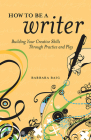 But, writing something for public consumption is not the same as freewriting, practice, PLAY. I’ve been reading HOW TO BE A WRITER by Barbara Baig and the first thing she addresses is this need to free ourselves from expectation and play with writing, without fear of anyone else seeing the results. I’ve been seeing this advice show up in various snippets here and there from various wise people for the past few weeks. The universe is sending me signals, but I’ve been trying hard to overlook them to focus instead on the “should“s, the concrete to-do list, the goal-oriented approach to achieving my dreams.
I’m a logical person. I write nonfiction. I make lists. I set goals, and break them down, and work towards them. This is all good and useful… to a point.
But sometimes, the well runs dry. I need to rest. I need to read. I NEED to create. That, after all, is the end goal. So, it’s time to listen to the universe.
You, dear revisions, will just have to wait. I’m currently busy with much less important things.
Review: Only the Mountains Do Not Move
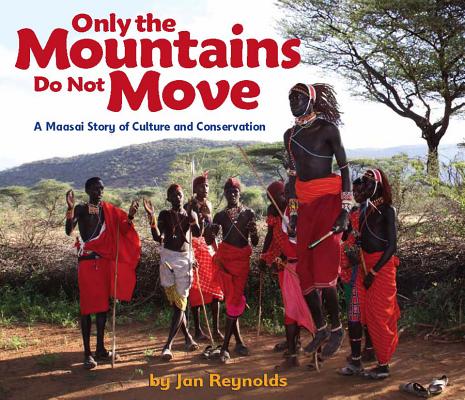
Only the Mountains Do Not Move: A Maasai Story of Culture and Conservation
by Jan Reynolds
Lee & Low Books, September 01, 2011
40 pages
Grades 3–4
I’ve always been fascinated by the Maasai, so I was pleased to see this book about their culture written for children, and this book didn’t disappoint. Straightforward text is combined with Maasai proverbs and beautiful photography to give us a detailed glimpse at modern-day Maasai life. This is a balanced representation: Reynolds isn’t afraid to show the less pleasant (biting bugs!) or shocking (drinking cow blood!) aspects of Maasai life, but she also reveals the peace and togetherness it brings. Especially relevant to her young readers is how she focuses on what the Maasai boys and girls do at different ages.
One pleasant surprise was how Reynolds shares with readers not only the historical Maasai culture, but also how the Maasai way of life is changing due to outside pressures and how they are adapting to this new world, giving the story context in the broader world.
I’d be remiss, however, if I didn’t mention that there were a few minor drawbacks for me. First, it bothered me not to have pronunciation guides for the Maa words embedded in the text (but there is one at the end). Second, although the Maasai proverbs were lovely, I wanted more of them and to have them appear more regularly throughout the text. As it is, with 10–14 pages between proverbs, they sort of surprised me each time and felt more like interruptions than the embellishments they should have been. Finally, I would have liked to get a little closer to the main family throughout the whole book. Sometimes the text seems to move way out to the Maasai in general for a long time, then it zooms in briefly to the main characters, then goes right back out again. I would’ve liked more connections to have been made between the general way of life and the specific family.
On the plus side, the back matter includes an author’s note, a glossary and pronunciation guide, a web site for more information, and source notes and acknowledgements. There’s also a very interesting interview and book talk with the author available here, which should make it ever more appealing for teachers hoping to use it in the classroom.
This is a wonderful book for introducing a unique and fascinating African culture to upper elementary students.
Lessons learned at the 2011 SCBWI WWA retreat


I had such a great time at SCBWI Western Washington’s Weekend on the Water retreat this year. Nestled in a cozy lodge-style resort on the Hood Canal, 49 other writers and I had the privilege of learning from superstars Arthur A. Levine and Linda Sue Park. I wanted to capture and share just a few of the nuggets of wisdom I gleaned from their talks, so here goes…

From Arthur:
- First chapters are like first dates. You need a spark, but also must establish trust if there is to be a long-term relationship. You must choose an appropriate setting for the mood you wish to create. Choose the right outfit—don’t write to trends if they don’t suit you. Don’t give too much away in the beginning—keep a few surprises for later. Be honest. Don’t rush in.
- Think about your story’s “best self,” the most important aspect of your book and hopefully, the one you are best at. Is it character? Plot? Voice? Setting? Yes, you need them all, of course, but one probably stands out as the key element or your best trait. Be sure to lead with that component in the first chapter, both to make a good impression and set the stage for what comes next.
- Make sure your story’s “beating heart” is revealed in the first chapter. What’s the emotional theme?
- You can’t start writing with a moral or theme in mind. Go back to the characters and find out why it matters.
- Main characters will have thoughts and feelings about the facts you need to present. Reveal character through description to get two for one.
- When receiving feedback, be sure to ask WHY critiquers are making their suggestions. Don’t just make the changes they propose without understanding the real reasons behind them.
- Enjoy the journey!

From Linda Sue:
- Young children are learning about THEIR WORLD. Middle-grade children are learning about THE WORLD. Young-adult readers are learning about THEMSELVES. “Reading is practice for life.”
- Without showing the where and when of setting, you only reveal part of character. Tell readers how your characters interact with their environment, not just what the environment is.
- Every sentence should do double-duty (plot + character, plot + setting, or setting + character). Look for this during revision.
- Try it! Instead of just thinking about something, (1st person POV vs. 3rd person, present vs. past, different structures and timelines, different settings, etc.), try it both ways and see what you like better. Don’t be afraid of wasting time! This is the work of writing.
- Using present tense for what is happening right now is technically incorrect. Present tense is for things that happen every day or are routine. Present participle (-ing) is for what’s happening right now. “I sing” vs. “I’m singing.” But it’d be awfully cumbersome to right a 1st person present novel this way!
- Use line breaks to see the rhythm and length of sentences in a picture book. Edit it as free verse, then put it back together for manuscript form.
- Act out the parts and try reading your work out loud AS your characters! This helps you catch things they wouldn’t say or do and guarantee authenticity.
- Write one scene at a time. In every scene, you only have to choose if there will be progress or impediment, and which quest will affect, internal or external? Now make it MOVE—every scene needs some kind of action.
- Even if you don’t believe in yourself, believe in your STORY.
- The only way to know what’s good is to read—a LOT!
There was so much more from each of them that my notebook (not to mention my brain) is full! If you ever get the chance to hear either one of them speak, don’t let it pass you by. They are both phenomenal.
Another great component of the retreat is learning from the other talented writers in attendance. We had peer critique groups, networking and social time, and work shared aloud throughout the weekend. So, with all of that feedback and learning in mind… back to revisions!
Jean Reidy’s Light Up the Library Auction
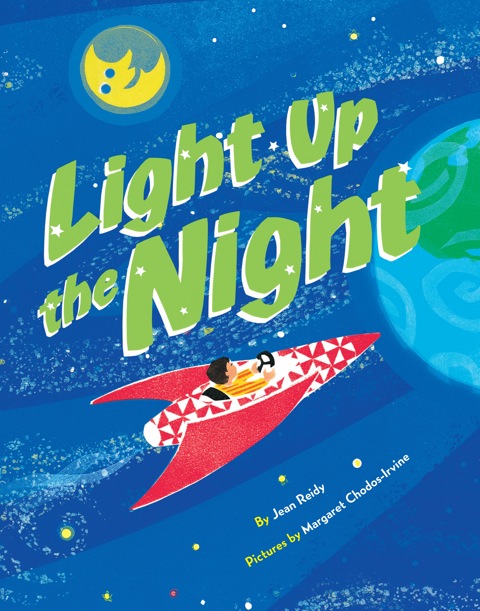
Author Jean Reidy’s new picture book, LIGHT UP THE NIGHT (Hyperion, October 2011) was inspired by her connections to Uganda and its children, many of whom have been displace due to past civil war or orphaned by AIDS. To celebrate the release of the book and honor those children, she is holding an online auction to benefit literacy in Africa and a library at Musana Children’s Home in Iganga, Uganda.
There are all kinds of great items available including:
- signed books,
- manuscript critiques (including one by yours truly and other fabulous clients of Erin Murphy Literary Agency; another by my thoroughly wonderful agent, Ammi-Joan Paquette; and another from fab kidlit agent Erin Murphy),
- a chance to submit your manuscript to an editor at Bloomsbury,
- a one-hour author marketing consultation,
- personal social media strategy consultation,
- author visits,
- original art,
- handmade jewelry and other items, etc.
Find out how it all works and start placing your bids here. But hurry! The auction ends November 18, 2011.
November is PiBoIdMo!
For many writers, November is National Novel Writing Month (NaNoWriMo), a month-long commitment to creativity wherein writers turn off their inner critics and pound out a complete 50,000-word novel in 30 days. I’ve seen the results, and it’s nothing short of amazing. A self-imposed deadline can be very motivating, especially when shared with others!
Alas, how could picture-book writers join in the fun and enthusiasm? I suppose you could try to hammer out 100 500-word picture books in a month, but writing 100 different stories, even if they’re short, is a very different beast than writing just one long one. It may not take long to write the first draft of a picture book, but it can take a very long time to find one really great picture-book idea (and we won’t even talk about revisions!).
Last February, I participated in a month-long picture-book writing marathon, where we challenged ourselves to write 26 picture books in 28 days, and it was a fantastic experience. In fact, two manuscripts from that experience are very close to being final drafts ready for submission. Of course, that means there were 24 that weren’t so great, ranging from “might be worth working on” to “total stinkers” (lots more in that category, to be sure), but still, I feel it was well worth the time–and a ton of fun!
Perhaps an even better idea, and certainly less intimidating now that I’ve done the picture-book marathon, is Tara Lazar’s Picture Book Idea Month (PiBoIdMo). Sign up starts today, right here!
If you’ve ever even thought about writing picture books, I urge you to try this challenge! So far, almost 300 people have signed up, so there will be camaraderie. Tara will feature daily inspiration and guest bloggers to help keep us going. And, as if that wasn’t enough, there will be PRIZES: signed books, picture-book manuscript critiques, original art by picture-book illustrators, book jewelry, hand-made journals, vintage children’s books, and feedback from one of three literary agents!
I’ll hope you’ll join me, Tara, and hundreds of other picture books writers for this year’s PiBoIdMo. Please let me know in the comments if you’re participating!
My article in Odyssey about non-Newtonian fluids
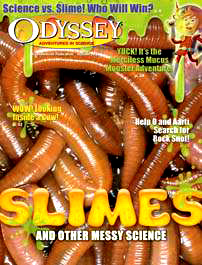
Odyssey does such a great job with their science magazine for kids. Check out the cover of this month’s issue for October 2011, with the theme “Slimes and Other Messy Science:”
FUN, no? And here’s my article and activity, which appear on pages 20–24:
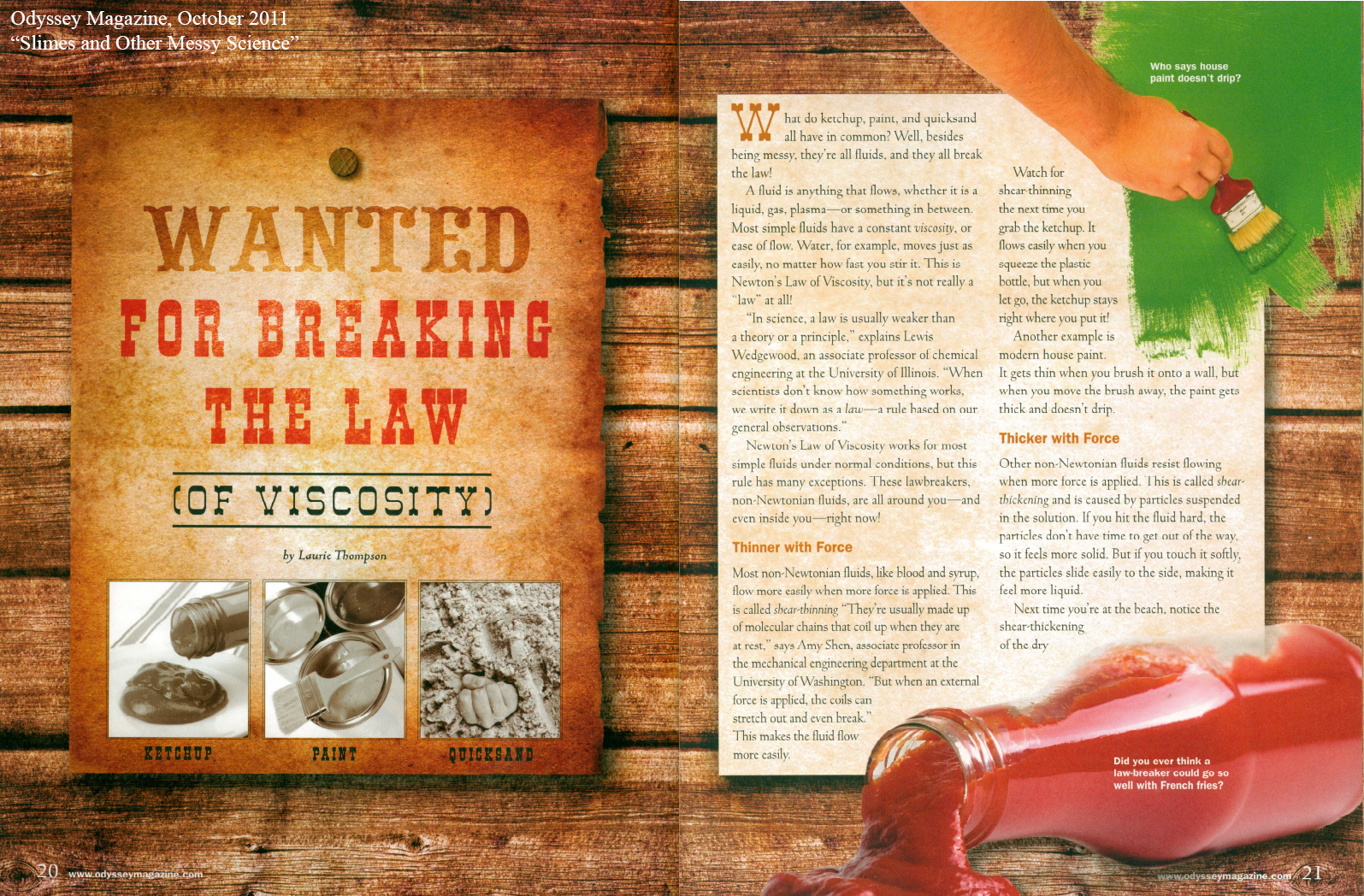
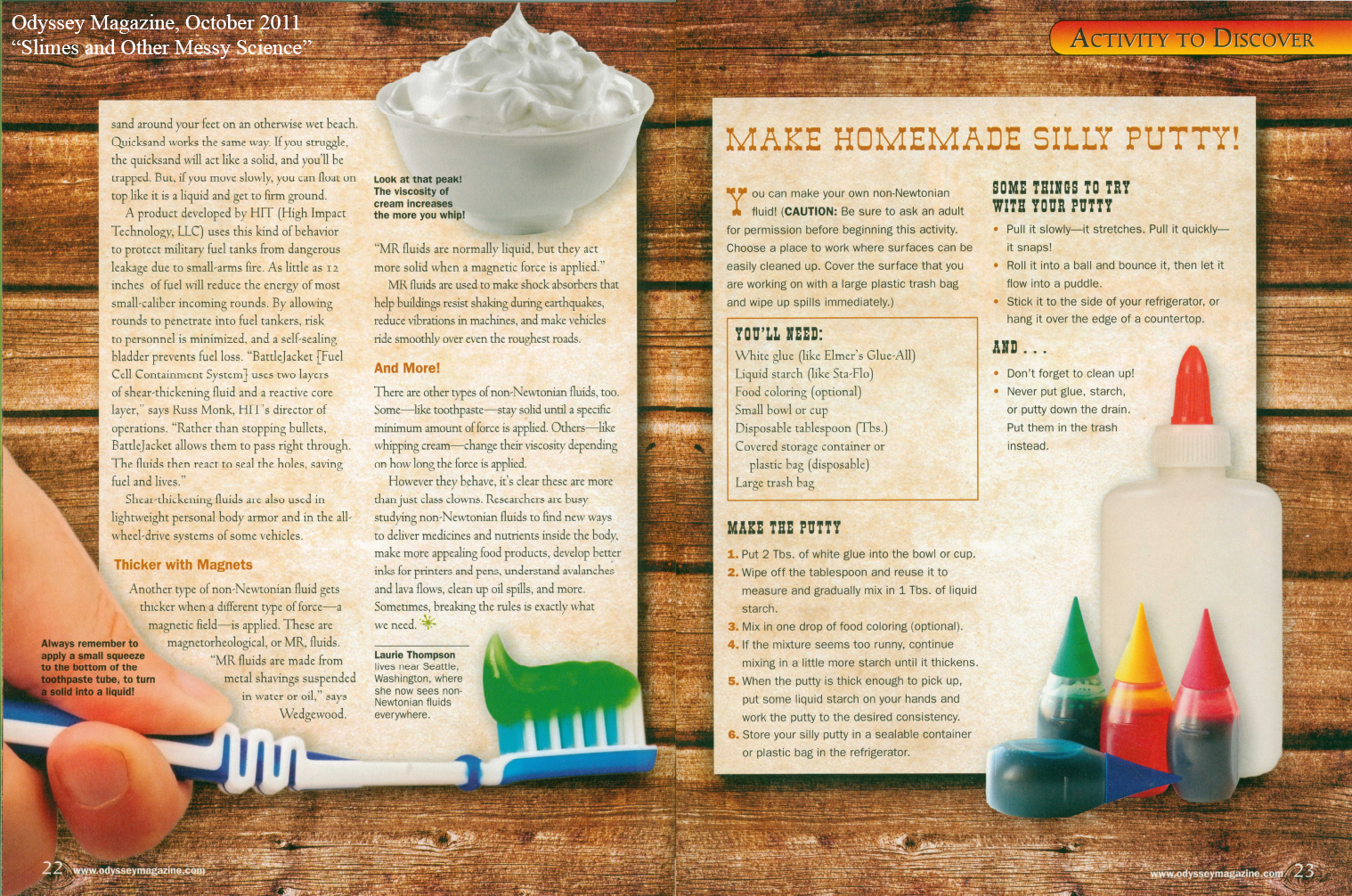
Enjoy!
Humor in nonfiction books for kids
Some people think nonfiction is dry and boring. How can facts be fun, right? WRONG! Humor in nonfiction not only gets and keeps readers engaged, it can also help them retain the information longer. My fellow writers of nonfiction for kids (on the NFforKids Yahoo group and on Twitter) and I have put together a list of our favorite FUNNY nonfiction titles for kids. Here’s what we came up with, in no particular order:
- Just the Right Size, Extreme Animals (and others) by Nicola Davies
- How to Get Organized Without Losing It by Janet S. Fox
- How To Do Homework Without Throwing Up by Trevor Romain
- Manners Mash-Up: A Goofy Guide to Good Behavior by Tedd Arnold and others
- What To Do About Alice by Barbara Kerley
- The Basher books (Physics, Periodic Table, Biology, etc.) by Simon Basher
- Kathleen Krull’s Lives of the… series
- You Wouldn’t Have Wanted To Be A… series by various authors
- Fingers, Forks, & Chopsticks by Patricia Lauber
- Poop Happened by Sarah Albee
- Americapedia by Jodi Lynn Anderson, Daniel Ehrenhaft, Andisheh Nouraee
- How They Croaked by Georgia Bragg
- Bugs and Bugsicles: Insects in the Winter by Amy Hansen
- What to Expect When You’re Expecting… series by Bridget Heos
- It’s Spit-acular: The Secrets of Saliva by Melissa Stewart
- The Truth About Poop by Susan E. Goodman
- Gee Whiz by Susan E. Goodman
- See How They Run by Susan E. Goodman
- Fartiste by Kathleen Krull (which I blogged about here)
- Do Pigs Have Stripes? by Melanie Walsh
- Bubble Homes and Fish Farts by Fiona Bayrock
- Ant, Ant, Ant, An Insect Chant by April Pulley Sayre
- What’s So Funny? Making Sense of Humor by Donna M. Jackson
This is just a sampling of our favorites. Do you have any to add? Please let us know in the comments!
I found it interesting that often the humor is primarily in the illustrations, with the text playing it fairly straight. In fact, in many cases it’s only the juxtaposition of the two that tickles your funny bone. In others, the humor is mild (a smile rather than a belly laugh) or is just hinted at rather than being an explicit joke. Sometimes, the topic itself is pretty funny, but the text is fairly serious. Given how much kids love to read humor, I wonder if that’s all just coincidence, or if humor just isn’t as tolerated in nonfiction texts, or maybe nonfiction writers just don’t have a sense of humor (I’m sure not buying that last one!). Thoughts?
2011 CYBILS, Nonfiction Picture Books… and me!
I’m absolutely thrilled to announce that I’ve been selected to serve as a judge in the nonfiction picture book (NFPB) category of the 2011 CYBILS (Children’s and Young Adult Blogger’s Literary Awards)!
I write nonfiction picture books, so I read a lot of nonfiction picture books. Now, I get to help recognize the best of the best. Nominations have opened, titles are rolling in, and I’ve already started reading. You can see what has been nominated here, and you can add your own nomination here. I’m not sure I’ll get much writing done in October, but it will be an epic month of great reading, I’m sure! Stay tuned for reviews of nominated titles.
STEM Friday Book Review: The Case of the Vanishing Golden Frogs
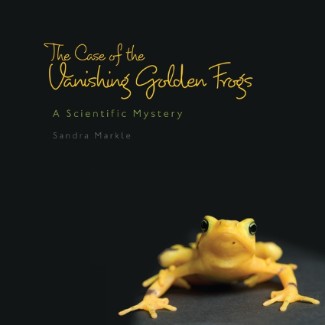
The Case of the Vanishing Golden Frogs: A Scientific Mystery
(Exceptional Science Titles for Intermediate Grades series)
by Sandra Markle (Author)
Millbook Press (Lerner), October 2011
48 pages
Ages: 9–12
From the publisher’s web page:
Panamanian golden frogs aren’t just cute, little, and yellow. They’re also the national symbol of Panama. But they started to disappear about fifteen years ago. What’s killing them? Could it be a change in their habitat? What about pollution? Might it be a result of climate change? Follow a team of scientists working to save these frogs and protect frog populations worldwide in this real-life science mystery.
Sandra Markle is one of my favorite authors, and frogs are high on my list of favorite animals, so I was thrilled to have a chance to preview this title. And I wasn’t disappointed. The text is informative and easy to understand, but also tells a fascinating and compelling story.
Markle does a great job of capturing both the importance and the fun of science. First, she explains why the disappearance of these tiny creatures matters. Then, she lays out how the mystery unfolded: what questions different scientists asked, and how the answers led to the next piece of the puzzle–and more questions, for other scientists, etc.
In fact, that’s one of the things I appreciated most about this book: it doesn’t follow just one scientist and his or her unique work. It demonstrates how one person’s findings sparked others to advance the science, and how each used his or her own expertise and knowledge to contribute the next vital step in the ongoing process. To me, that makes science feel more accessible to kids by showing that successful scientists don’t need to solve a whole big problem, they just need to learn something new and tell others.
Aside from the masterful text, the stunning layout and design and big, bold photographs on every page make the book visually engaging throughout and are more than enough to keep young readers turning the pages to see what’s next.
In the author’s note, Markle adds this:
No tale of finding a serial killer could be more exciting than this true story.… But the story isn’t over yet. The amphibian killer is still at large. Perhaps, one day, one of you will become the science detective who finally stops this killer.
The book also includes a table of contents, “how to help” section, glossary, age-appropriate recommended resources, index, and photo credits.
To check out the rest of today’s roundup of books for kids about topics in science, technology, engineering, and mathematics, head on over to this week’s STEM Friday host, Rasco From RIF!