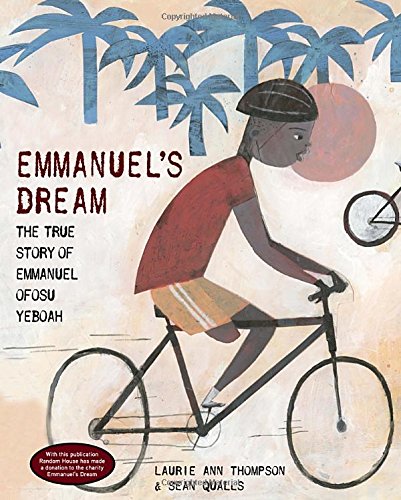
A couple of weeks ago I announced giveaways here and on Goodreads for both Be a Changemaker and Emmanuel’s Dream. We have winners!
From my list of newsletter subscribers, chosen by Random.org, the winners are… Jim McGinley wins a signed copy of Be a Changemaker! I swear it was completely random, but this is just so perfect. Jim was one of the very first people to help and encourage me on my quest to write this book, and his early support meant a lot to me. He’s even mentioned in the acknowledgements. Sometimes fate is hard to deny, you know? The winner of a signed copy of Emmanuel’s Dream is Lindsay Fouts! This seems like a great fit, too, since Lindsay is both a picture book writer and the mother of a young son. I hope they enjoy the book.
And on Goodreads, the winners were far flung: Adage from Romania won Be a Changemaker, and Jessy from India won Emmanuel’s Dream. Yes, it’ll cost me a little extra in postage, but it’s exciting to know that my books will be traveling around the world!
Finally, in case anyone is curious, some giveaway stats from Goodreads…
1004 people requested Emmanuel’s Dream and 464 added it to their To-Read shelf, and
1441 people requested Be a Changemaker and 610 added it to their To-Read shelf.
I recently posted a review of a fiction picture book called NEW SHOES. I love the book so much, and today I’m thrilled to welcome the author, Susan Lynn Meyer, to the blog! Susan was kind enough to answer a few of my questions. I hope you’ll enjoy getting to know her a little better. I know I did!
Susan Lynn Meyer LT: Welcome, Susan! I’m so excited to learn more of the story behind the story of NEW SHOES.
SLM: Hi Laurie! Thanks so much for your interest in NEW SHOES. LT: How did you first become interested in writing about the Jim Crow time period, and what in particular led to thinking about framing it in the context of trying on shoes?
SLM: I was reading about segregation from the 1940s onward both just because I was interested and as research for a novel I just finished writing. (It is called SKATING WITH THE STATUE OF LIBERTY and it’s about Gustave, a twelve-year-old French Jewish refugee who comes to New York in 1942 because his family is fleeing the Nazis.) I was startled to come across a piece of information I hadn’t known about—that in many stores, African-Americans were not permitted to try on clothes, hats, or shoes. I thought a lot about what that must have felt like, especially for a child encountering it for the first time. As I mulled that over, it began to shape itself into a story. LT: I love that, how one book project sparks and informs another, and in a different genre and on fairly different subject, too. How much research did you do for this book? Can you tell us about that process? During your research, did anything surprise you, catch you off guard, or make you change your planned course for the book?
SLM: I’m lucky because I have access to a terrific academic library since I’m also an English professor at Wellesley College. I went to the stacks, checked out a lot of books about Jim Crow, and started reading! Among the most intriguing things I came across were accounts of the ways, large and small, that African-Americans coped with Jim Crow, the psychological and practical strategies they used. Parents would make sure to bring along water so that their kids didn’t have to face segregated drinking fountains. People would refuse to patronize restaurants where proprietors refused to seat them and would only sell them food by handing it out the back door. I loved the story of one black teenager who had a job at a grocery store and who was infuriated by the stupidity of the fact that brown eggs and white eggs had different prices—and that white eggs were cheaper because they were “better.” So he’d secretly switch the eggs around, mixing them up in the cartons! (I put that incident in the novel I just finished, but I ended up taking it out. I love it so much that I may use it again someday!)
SLM: The hardest thing about writing NEW SHOES (it went through 23 drafts over several years) was figuring out what Ella Mae and Charlotte could do to resist the unfair situation they found themselves in. The solution they come up with isn’t perfect, in the sense that the shoes are still second-hand, but people can buy them with dignity. Sales at Mr. Johnson’s shoe store, where Ella Mae hasn’t been allowed to try on shoes, are likely to suffer as a result, which is a nice additional benefit. LT: In EMMANUEL’S DREAM, I wrote about a disabled man from Ghana, despite being none of those things myself. I know people have questioned if I should’ve been the one to write that story, despite the fact that I did extensive research and had the manuscript vetted many times along the way, including by Emmanuel himself. IT was a story I felt I had to tell, in part because no one else had, but also because I could so identify with the emotions involved, even if not the specific experiences. Clearly you also believe that it is okay to write outside of our own culture, as long as we do so with care and respect. What do you say to people who question your authority to write this book?
SLM: All I can really say is that I write the stories that come to me. When I found out about this aspect of Jim Crow, it really hit home for me, and I mused a lot about what that would have felt like, especially for a child encountering it for the first time. Imagining and wondering led me to this story. I’m not demographically similar to any of the protagonists in the books I’ve had published so far, actually—I’m not a black American girl living in the 1950s and I’m not a French Jewish boy living in the 1940s either (as in my novel BLACK RADISHES or the sequel to it that I just completed, SKATING WITH THE STATUE OF LIBERTY). Writing fiction is about imagining your way into a character who is not you—and trying to do it so effectively that your reader is drawn in as well. Writing for children especially involves this kind of leap—because all the writers are adults trying to imagine their ways into the minds of children. Writing across gender or time or nationality also requires this kind of leap.
SLM: But in order to be persuasive to the reader, that imaginative leap has to be an informed one, and it was also important for me to get the reaction of black friends to NEW SHOES when it was in draft. One early reader told me something that really resonated with me. I had initially had Ella Mae’s mother directly express anger after the shoe store incident. But this friend said that her older relatives would not have talked that way about racism to their children, that to protect the child, they would have encouraged the child to think positively. When I thought about my own older relatives and also about the way I am as a parent, that felt so intuitively right to me. So I changed Ella Mae’s mother’s answer. Now she tells Ella Mae that she should think about how nice her feet will look for school. And that feels so much more like what a parent in those circumstances would do. I’m really grateful for that reader’s early response. LT: Oh, I love that answer! So, how exactly were you able to “imagine your way into a character who is not you” in this case? How did you put yourself in someone else’s shoes (no pun intended), and tell a story that—on the surface, at least—you have no direct experience with? What was the personal connection for you?
SLM: In some ways, my own experiences inevitably find their way into anything that I write. I was one of six children, money was limited, and we wore a lot of hand-me-downs. I now enjoy telling students at the schools I visit about an absolutely humiliating experience I once had with hand-me-down boy’s long underwear. (Don’t ask!) My parents also had me and my brothers and sisters polish our school shoes every weekend and we washed the shoelaces when we did it. I’ve never asked to find out if anybody else did that! I wasn’t great as a kid about doing chores—who is?—but I actually didn’t mind polishing my shoes and I found washing the dirt out of the shoelaces, the way Ella Mae does, very satisfying. On a deeper level, there’s the issue of injustice of all kinds, which I was very attuned to as a child. I often said furiously, “It isn’t fair!”—and I hope kids will have an intense reaction of this kind to the situation in NEW SHOES. LT: Well, I’ve never polished shoes or washed shoelaces, but I’m sure almost every kid—including me—has roared, “It isn’t fair!” It’s kind of sad that we become more desensitized to injustice as we get older. LT: I think every book teaches us something new, about the world, about ourselves, or about the craft of writing. What have you learned as a result of writing this book? What surprised you the most during the process?
SLM: I loved hearing from Eric Velasquez about his method of illustration, and it really made me realize how much a picture book is a truly collaborative process. Eric has models pose, takes photographs, and then paints from those photographs. He chose two girls who were friends to pose for Ella Mae and Charlotte, because he wanted their closeness to show in their body language. It is wonderful to me to look at his paintings and to think about all the people besides me—Eric Velasquez, the models, as well as all the people working at Holiday House—who came together to create this book. I also especially love the end papers Eric designed for the book, which are tracings of one of his girl model’s feet. They encapsulate what the story is about so wonderfully in a simple and powerful visual image. LT: Yes, I loved the end papers, too! And the illustrations are so beautifully realistic. Kudos to Eric! LT: I always said that I would know I’d made it when I received one letter from one child saying that something I wrote made a positive difference in his or her life. How do you define success? Do you feel like you’ve achieved it? If not, what’s left on your to-do list?
SLM: I think I’m always going to want to write another book and get it published, so I don’t know if I’ll ever really feel as if I’m at the point of success! But the other day, I checked out a book from the public library, and it been read so many times that the pages were soft they were about to tear. What I want more than huge sales is to have my books find a home in libraries and stay there for many years waiting for a child to come along and pick them up. I think when I come upon a copy of one of my books in a library and the pages are as worn and soft as the pages of that book—that’s when I will have achieved success. LT: That’s a wonderful image and a perfect definition of success. LT: Thanks so much for taking the time to answer my questions, Susan! It’s been lovely to learn more about your process.
SLM: Thank you so much for having me on your blog!
DOABLE: THE GIRLS’ GUIDE TO ACCOMPLISHING JUST ABOUT ANYTHING by Deborah Reber Beyond Words/Simon Pulse (January 2015)
In this well-organized, easy-to-digest nonfiction book for teen girls, Reber employs her training as a life coach as well as her extensive work with teen girls to lay out an eight-step plan for readers to achieve whatever it is they want to tackle in life. The steps include defining the goal, defending against obstacles, developing support systems, determining what success looks like, doing the work, dealing with setbacks, and delivering the goods. Each step has numerous examples, pullouts, journal exercises, and more, and every chapter ends with a summary to reinforce the main points. Reber manages to do all of that while maintaining a charisma and relatability that puts readers at ease while at the same time empowering them, and the tone is never the least bit condescending nor overwhelming.
I loved this book and plan to refer back to it for my own to-do list management. In fact, my one and only quibble with this book is that it is targeted solely at teen girls, because I think EVERYONE over the age of 10 should read this book! I think we could all learn a thing or two from it that would make us more successful and make our lives that much easier. That said, Reber is perfectly in touch with the teen girl audience, and while the core content is highly applicable to any reader, the voice and viewpoint will surely be directly relevant and relatable to many teenage girls. This book would make a great eighth grade or high school graduation present, and it’s a super helpful read for anyone who wants to be more productive (don’t we all?). Far from being didactic, DOABLE instills a sense of confidence and excitement. Reber is a fantastic coach AND a cheerleader, all rolled into one. Highly recommended!
NEW SHOES written by Susan Lynn Meyer illustrated by Eric Velasquez published by Holiday House (February 2015)
It’s not easy to write a picture book for young kids that tackles a tough subject in an age-appropriate way. And it’s even harder to do so while still being entertaining. NEW SHOES by Susan Lynn Meyer does all of that and more, and it does it so very beautifully.
Publisher’s summary:
Set in the South during the time of segregation, this lushly illustrated picture book brings the civil rights era to life for contemporary readers as two young girls find an inventive way to foil Jim Crow laws.
When her cousin’s hand-me-down shoes don’t fit, it is time for Ella Mae to get new ones. She is ecstatic, but when she and her mother arrive at Mr. Johnson’s shoe store, her happiness quickly turns to dejection. Ella Mae is unable to try on the shoes because of her skin color. Determined to fight back, Ella Mae and her cousin Charlotte work tirelessly to collect and restore old shoes, wiping, washing, and polishing them to perfection. The girls then have their very own shoe sale, giving the other African American members of their community a place to buy shoes where they can be treated fairly and “try on all the shoes they want.”
It’s hard for me to imagine not being allowed to try on shoes, and I must admit I never even realized that particular injustice was part of the Jim Crow laws. I’m glad to have been enlightened. Wanting to try on a pair of shoes is something that can be easily understood by young children, and they will be able to appreciate the unfairness of the situation in the shoe store.
What I really love about this book, though, is how the girls solve the problem themselves. They work hard to earn startup funds, they take great care and pride in launching their shoe store, and they solve a problem not just for themselves, but for their whole community! That is changemaking at its finest.
This moving and inspirational picture book belongs in every classroom in America. To make it even easier, the publisher’s web page for the book has classroom discussion questions and an educator’s guide, both with Common Core State Standards (CCSS) connections.
I hope you’ll check out NEW SHOES… and share it with others!
I’m so happy about the recent accolades my books have received that I’ve decided to host not just one giveaway–but FOUR!
To celebrate the fact that BE A CHANGEMAKER: HOW TO START SOMETHING THAT MATTERS was a finalist for the Cybils awards, I’ll be giving away a signed copy of the paperback edition on Goodreads, here:
AND, I’ll give away a signed copy of either one (winners get to choose!) to two random subscribers to my mailing list. If you’re not a subscriber yet, just sign up below. (I only send a short newsletter once/month.)
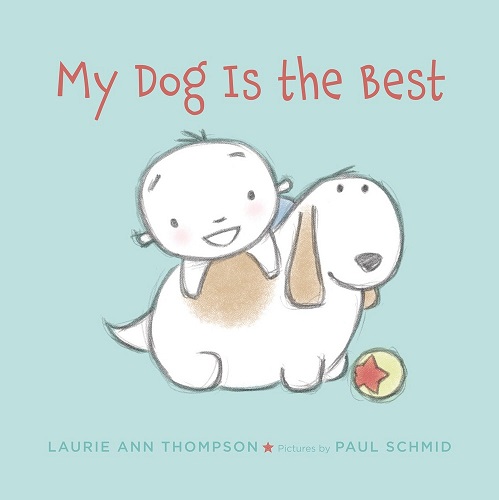
Finally, School Library Journal recently called my upcoming release “well-executed and charming.” I can’t give this one away just yet (it will release on June 9, 2015), but feel free to share the MY DOG IS THE BEST love by adding it to your Goodreads shelf and/or pre-ordering it at one of the following links:
Secret Garden Books (for a signed copy, please leave an extra week or so for delivery and indicate how you’d like it personalized in the “other notes about your order” field).
And, just for fun, here’s a cool video that John Schu made of the window display at Unabridged Bookstore in Chicago. It’s in great company, don’t you think? It’s always exciting to see one of my books out in the wild, so if you spot one, please share!
Happy Valentine’s Day to teachers and teacher/librarians!
I’ve never been very much into Valentine’s Day, but when Lynda Mullaly Hunt invited me to participate in this awesome book giveaway for teachers, I jumped at the chance! Authors do love teachers, and generally, teachers love books, so it’s a perfect opportunity for us to show a little love to those who are so often under-appreciated.
Just check out all of the amazing SIGNED books that will be won by one lucky teacher:
To enter to win this fabulous giveaway, teachers and teacher-librarians just need to:
1) Leave a comment on Lynda Mullaly Hunt’s blog about anything you wish.
OR
2) Share a post on Twitter with a link to this blog post and the hashtag #MGAuthorsLoveTeachers.
OR
3) RT someone else’s tweet with both the blog post link and hashtag.
Rules:
***Giveaway ends on Wednesday, February 18th, at 11:59 p.m. Winner will be announced on the 19th.
1) This is to show our appreciation for teachers and librarians, specifically. Therefore, the winner must have a school mailing address and be presently employed at that school.
***2) Please remember this giveaway is all about appreciation. We know that teachers do not get the appreciation they deserve. This giveaway is a reminder that WE appreciate TEACHERS. They are often the ones putting our books into the hands of the readers who need them. For that we are truly grateful. THANK YOU for what you do everyday–and for visiting our giveaway!
But wait, there’s more.… Several YA authors have also banded together to show their love of and appreciation for teachers by giving away their books, too! For more information about the #YAAuthorsLoveTeachers giveaway, click here.
Whether you’re a teacher or not, please share this post with all of your favorite teachers and teacher-librarians so they can enter the giveaways, and don’t forget to show them a little extra love!
It’s always a treat to receive an email like this from a parent:
Last night I read your book to my younger daughter.… She loved the book, and decided it was her new favorite and she wanted to take it to school when it was her student spotlight week. Today she and [her brother] were fighting over it in the car, and I read it to each of them for a bedtime story. At least this week, it’s a household favorite!
It’s especially great to know that Emmanuel’s story is touching young readers as much as it touched me.
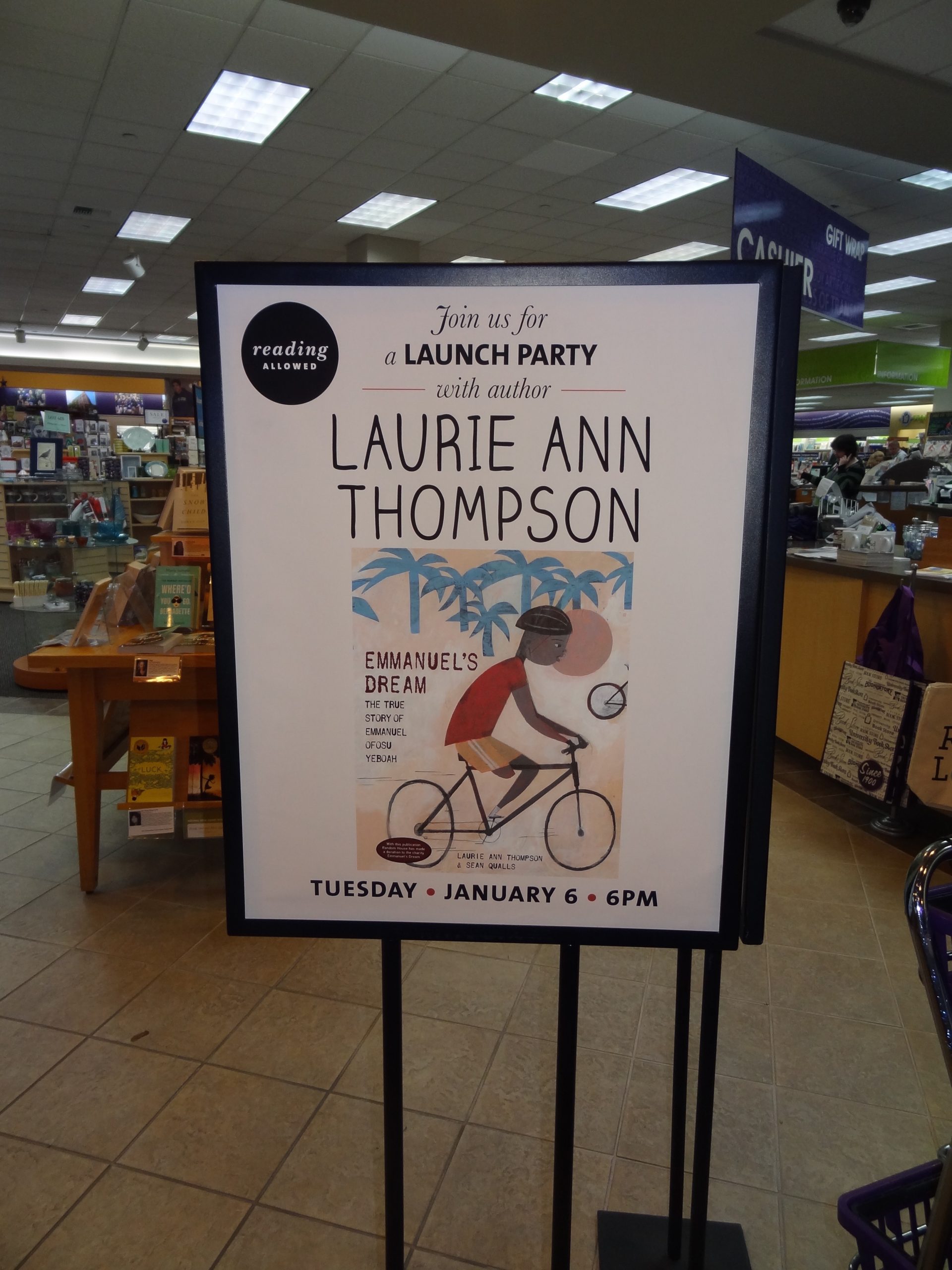
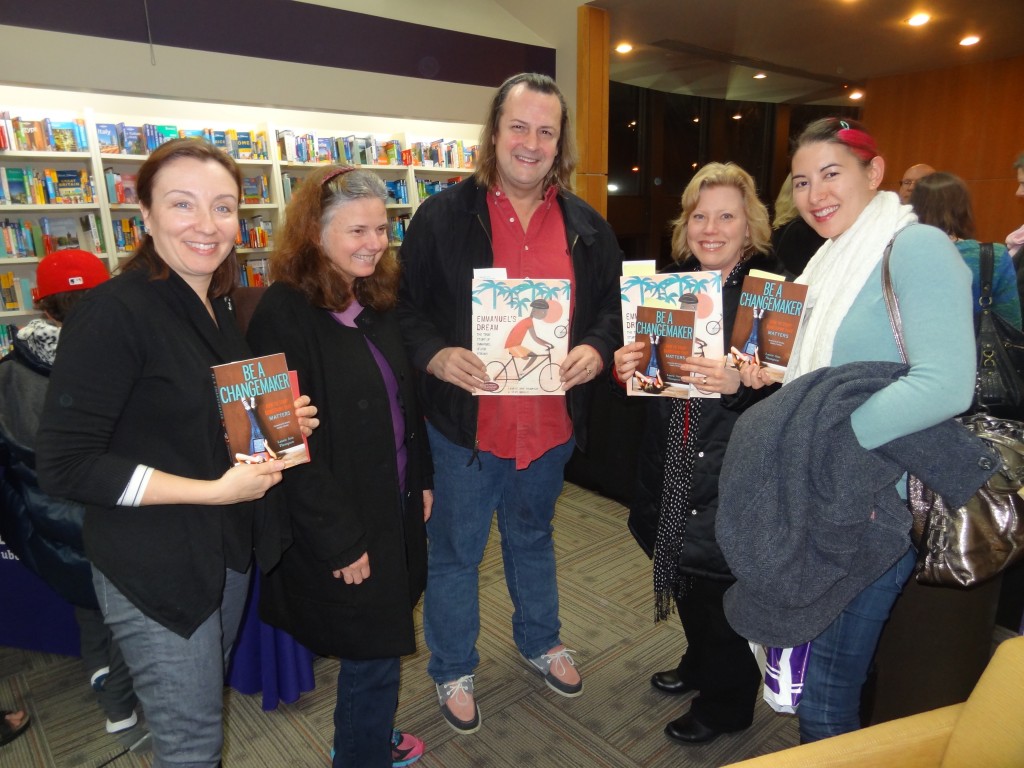
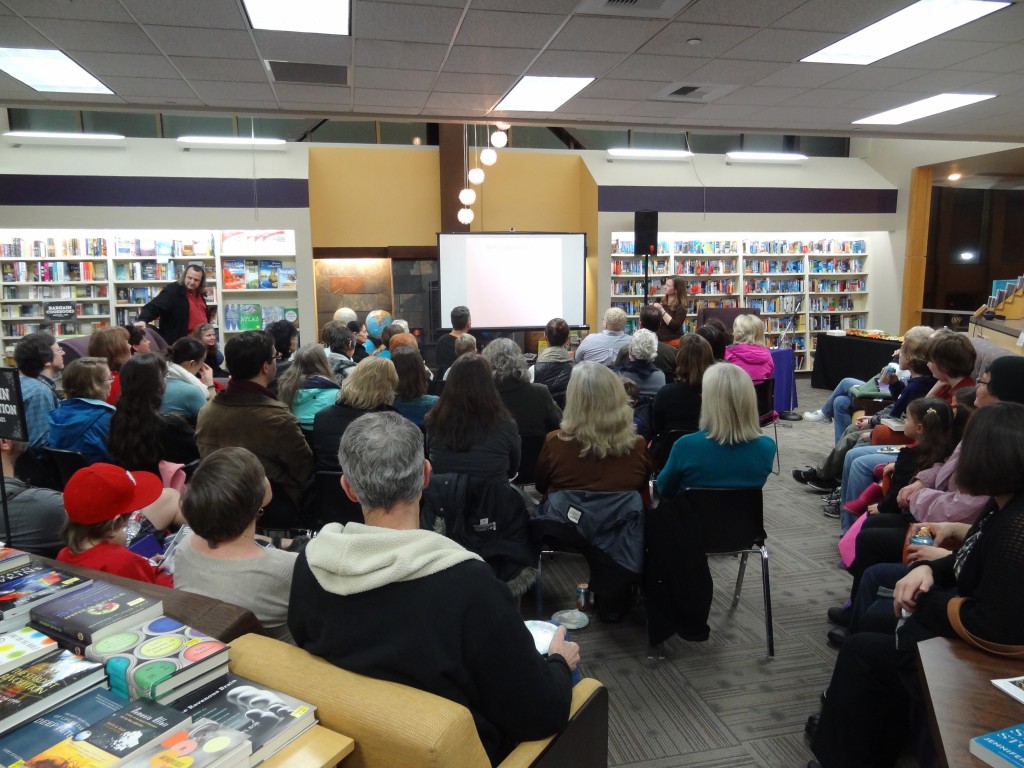
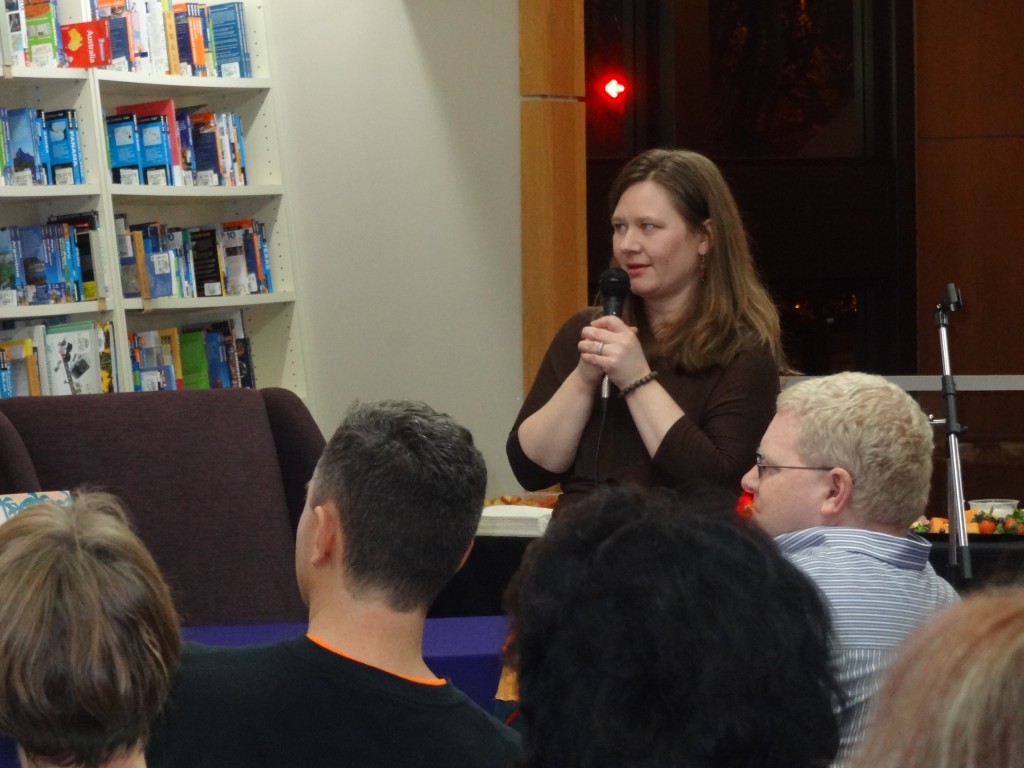
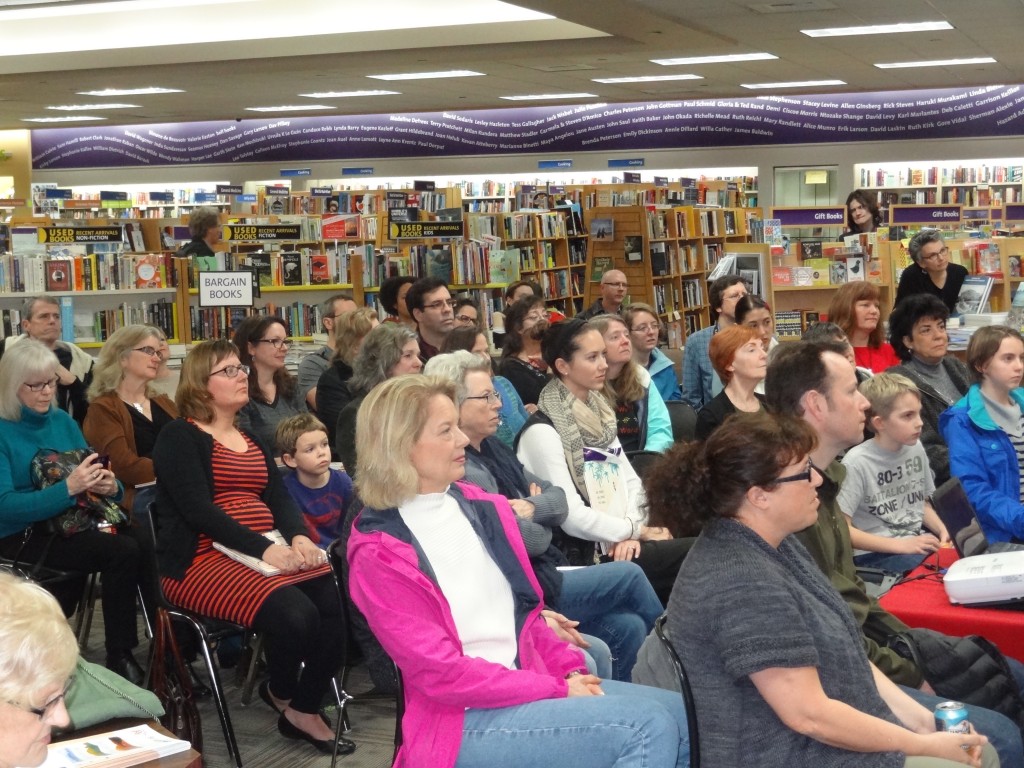
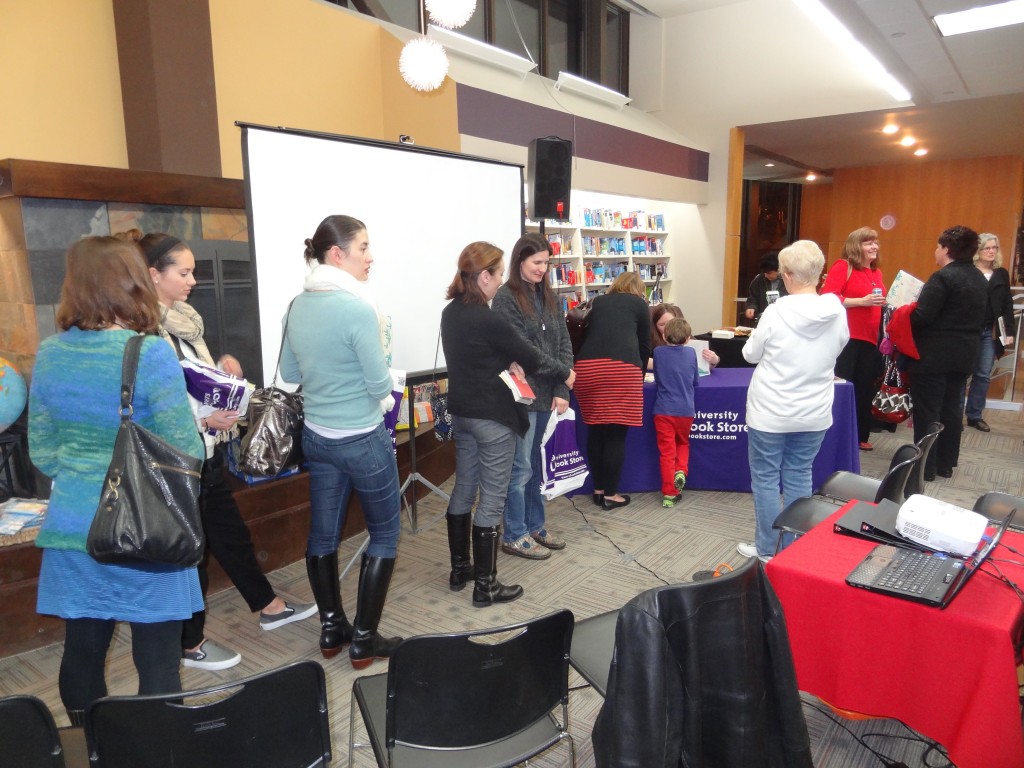
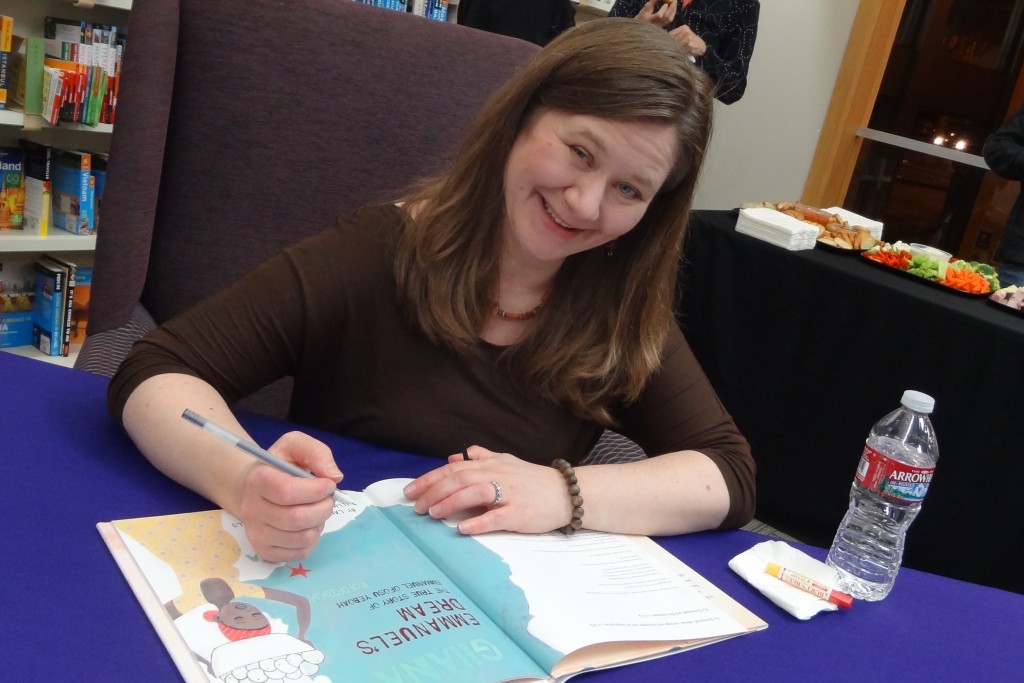
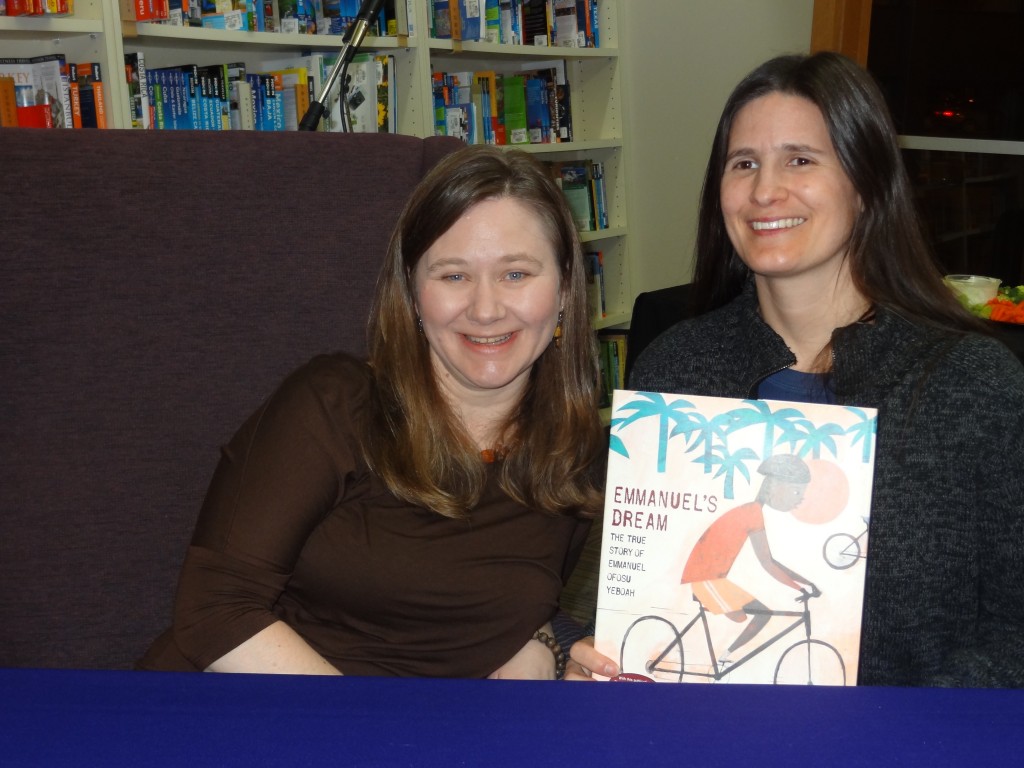
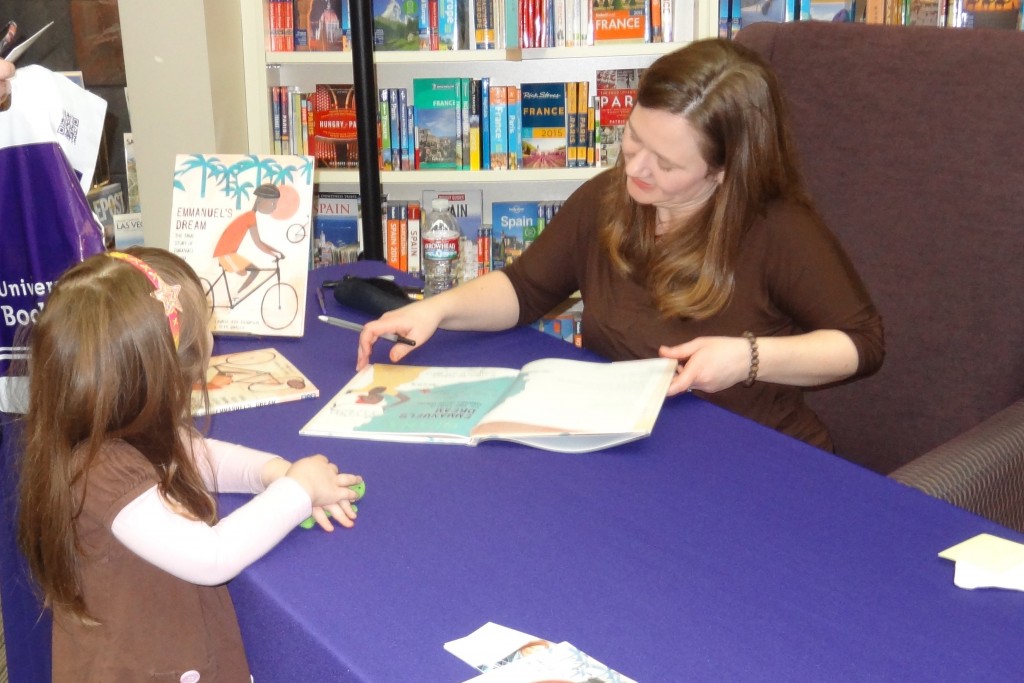
With the holidays right before, I must admit that the launch party day sort of snuck up on me. I was rushing to get everything ready, had to give up on some things that I wanted to do, and didn’t have as much time as I would’ve liked to prepare. Still, I think a great time was had by all. I know I enjoyed every minute!
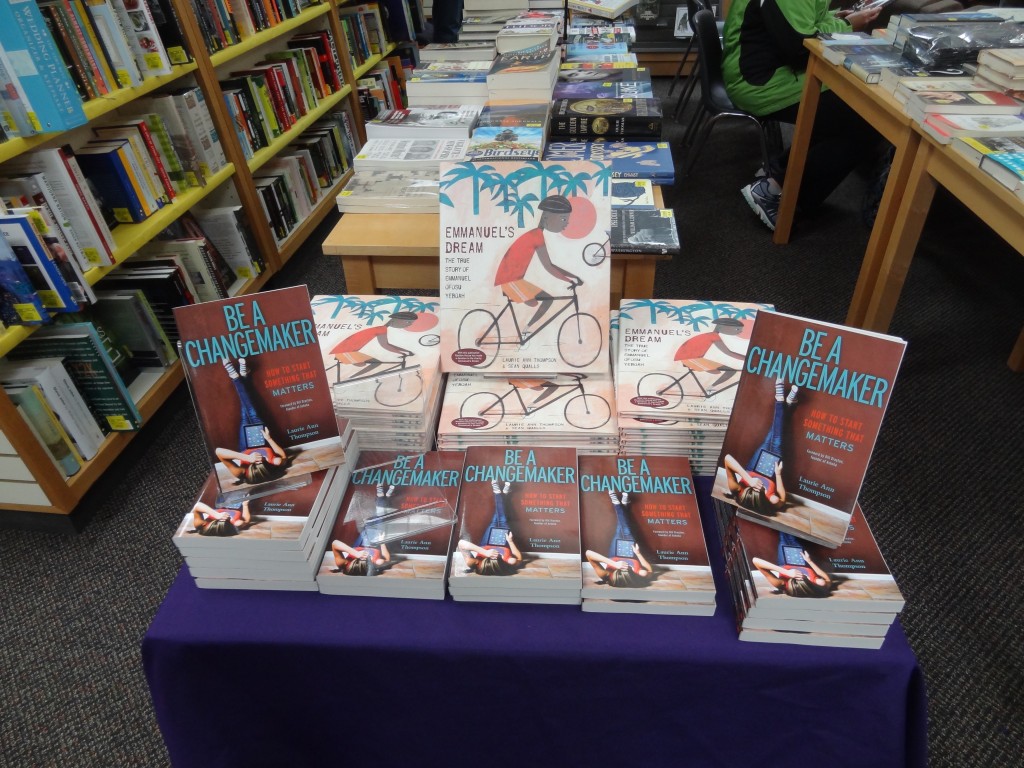
Check out the awesome poster they had up! Look at all those books for sale! Local writing buddies, including current Emu’s Debut blogger (and the next one of us to launch!), Kevan Atteberry! During the presentation Clutching the mic for dear life, apparently. The audience listening to my talk. Can you believe this line of people waiting to get their books signed? Signing books is even harder when you have to stop and pose for photos. Recognize this Emu’s Debuts emeritus and founding member? It’s J. Anderson Coats! Young fans are the best fans.
Many thanks to Emmanuel for inspiring me; to Sean Qualls for his beautiful artwork; to my family for supporting me all this time; to my critique group for helping the manuscript rise above the slush (especially Dana Sullivan, for taking these great pictures for me!); to my agent, Ammi-Joan Paquette, for not giving up; to the University Book Store in Bellevue and their event planner, Olivia Ahl, for throwing such a wonderful party; and to all the friends, writers, teachers, parents, neighbors, and community members who took the time to come out and cheer me–and the book–on last Tuesday night. You all ROCK, and I am one extremely lucky gal! xoxo
I woke up this morning to news that Be a Changemaker made the list of finalists for the 2014 Children’s and Young Adult Blogger’s Literary Award, better known as the Cybils, in the Nonfiction for Young Adults category. What a way to kick off 2015!
The nominations in this category were varied and impressive, and the books that made the finalist list are truly among the best I’ve read all year. It’s an incredible honor to have my book in such amazing company!
Alice + Freda Forever: A Murder in Memphis by Alexis Coe
Be a Changemaker: How to Start Something That Matters by Laurie Ann Thompson
Beyond Magenta: Transgender Teens Speak Out by Susan Kuklin
Popular: Vintage Wisdom for a Modern Geek by Maya Van Wagenen
The Family Romanov: Murder, Rebellion, and the Fall of Imperial Russia by Candace Fleming
The Freedom Summer Murders by Don Mitchell
The Port Chicago 50: Disaster, Mutiny, and the Fight for Civil Rights by Steve Sheinkin
Thanks, Pat Zietlow Miller, for nominating it in the first place. Thanks, Stephanie Charlefour at Love. Life. Read., for the finalist write-up, and to the entire panel (also including Aaron Maurer from Coffee for the Brain, Michelle Lockwood from Blogs Like a Girl, Karen Ball from Mrs. B’s Favorites, and Danyelle Leach from Bookshelves in the Cul-de–Sac) for reading, considering, and ultimately selecting it. I’ve been a first round Cybils judge twice and am a second round judge in a different category this year, so I know what a lot of hard work and dedication goes into it! Finally, thanks to the people who keep the Cybils running. It’s one of my favorite awards in children’s books as a reader, author, and judge. I’m always glad to be a part of it, so having my own book make that finalist list means even more to me. Kidlit bloggers ROCK! 🙂


 Jim McGinley wins a signed copy of Be a Changemaker! I swear it was completely random, but this is just so perfect. Jim was one of the very first people to help and encourage me on my quest to write this book, and his early support meant a lot to me. He’s even mentioned in the acknowledgements. Sometimes fate is hard to deny, you know?
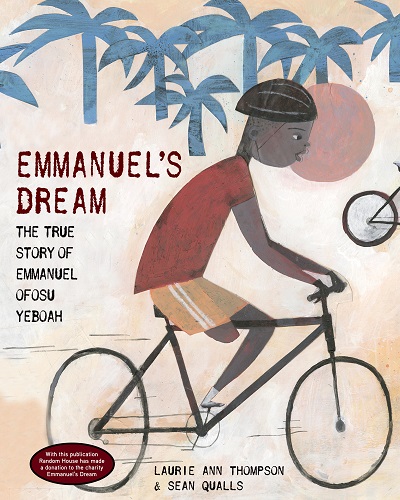 The winner of a signed copy of Emmanuel’s Dream is Lindsay Fouts! This seems like a great fit, too, since Lindsay is both a picture book writer and the mother of a young son. I hope they enjoy the book.