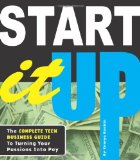
START IT UP by Kenrya Rankin is a must-have resource for teen (and even middle-grade) readers who wish to start any kind of business, whether it be for profit, nonprofit, or mixed.
The book is clearly written and easy to understand, yet includes a wealth of information for young entrepreneurs. The design is clean and functional, with pullouts for quick tips, anecdotes, quotes, and recommended resources. There are also fun quizzes and helpful worksheets. All of this combines to turn what could be a dull, dry topic into a fun, encouraging yet realistic resource.
I’d bet there’s enough substance there’s enough substance in this little gem that even the most seasoned entrepreneurs (adults included!) will find something of use here. And it’s presented in such a way that even the least business-minded individuals (again, adults included!) will be inspired and able to get started in no time.
For changing a life, or changing the world, this book is a winner! For more great nonfiction books, check out the rest of the catalog at Zest Books–Teen Reads With a Twist. (And no, I haven’t been compensated in any way for this post. I received a free galley from NetGalley for review purposes only.)
This post is part of the Facts First! Nonfiction Monday roundup. Nonfiction Monday takes place every Monday at various blogs throughout the kidlitosphere, who write about nonfiction books for kids and collect all the reviews in one place. This week, the Nonfiction Monday roundup is being hosted by Jean Little Library. To see the entire schedule, please visit the Nonfiction Monday blog.
Laurie Thompson
Do good by reading good YA: WHAT YOU WISH FOR
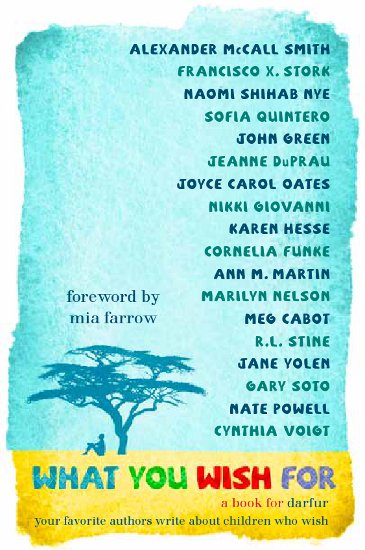
I just pre-ordered my copy of WHAT YOU WISH FOR: A BOOK FOR DARFUR, and I am so looking forward to reading it.
Coming from Penguin Group’s G.P. Putnam’s Sons in September, 2011, the book is a collection of YA poetry and short stories written by various authors, including Cornelia Funke, Meg Cabot, R. L. Stine, John Green, Ann M. Martin, Alexander McCall Smith, Cynthia Voigt, Karen Hesse, Joyce Carol Oates, Nikki Giovanni, Jane Yolen, Nate Powell, Gary Soto, Jeanne DuPrau, Francisco X. Stork, Marilyn Nelson, Naomi Shihab Nye, and Sofia Quintero.
Profits from the book sales will be donated to the United Nations High Commission for Refugees (UNHCR), an organization building libraries in Darfur refugee camps in Chad.
Read more here or pre-order your own copy here.
Review: I Am Tama, Lucky Cat
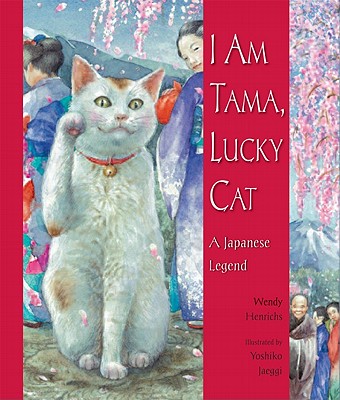
You’ve probably seen the smiling cat figurine with the waving right front paw, but have you ever wondered why it’s there? Told from the cat’s point of view, this charming 32-page picture book tells children one of the possible stories behind it with straightforward prose and stunning artwork. It can be enjoyed both for the story itself and as an introduction to or study of Japanese culture. Backmatter includes an author’s note and acknowledgements. Highly recommended.
Book information:
- Title: I Am Tama, Lucky Cat: A Japanese Legend
- Author: Wendy Henrichs
- Illustrator: Yoshiko Jaeggi
- Publisher: Peachtree Publishers
- Publication date: August 1, 2011
See other posts from this week’s Nonfiction Monday at Telling Kids the Truth: Writing Nonfiction for Children.
Note: I viewed this digital ARC via NetGalley and do not receive any compensation for this review.
Fans of FARTISTE

I’m a huge fan of Kathleen Krull’s nonfiction books for kids, so I was surprised and disappointed to read her recent article in the Horn Book about the difficulties she and her husband have had selling their book FARTISTE! I would’ve thought a picture book biography about a performer who entertained audiences with his mastery of the art of the fart would be an easy sell, to a publisher AND on the bookstore shelves! Doesn’t it sound like the perfect idea for a kids book?
Here’s a case in point. Yesterday, my son was having a bad day. I took him to the library because he said there was a book there that he wanted. He walked straight to an empty table in the children’s area and burst into tears. Come to find out, the book he wanted had been laying out on a table the last time we were in the library together—2 weeks ago—and now, to his surprise and great disappointment, it was gone. He didn’t remember what book it was, and couldn’t tell me anything about it, except how heartbroken he was and how no other book in the whole library would do.
I walked over to the shelf, grabbed a copy of FARTISTE (which was on my mind because I’d just read the Horn Book article and was still mulling over my own aforementioned surprise and disappointment), and handed it to my sobbing, inconsolable boy. “What’s this?” he asked skeptically, sticking out his bottom lip. I told him. Curious, he opened it up and read the first page. Engaged, he sank down to sit criss-cross in the floor in the middle of the aisle. 15 minutes or so later, a perfectly composed boy closed the book and said, “Thanks, Mom. That was a great book. Let’s take it home.” And he grabbed my hand and pulled me to the checkout counter.
So, thank you, Kathleen, for the Horn Book article. And a big thank you, Kathleen and Paul, from both of us, for sticking with FARTISTE. You have fans!
More thoughts on the speculative nonfiction debate
Roger Sutton put up this post on the Read Roger blog for continuing the discussion about Marc Aronson’s “New Knowledge” article in the Horn Book, in which Marc argues that nonfiction authors should be allowed to speculate, draw conclusions, and reveal their points of view in their books.
While I found Marc’s terminology of “new” versus “old” nonfiction to be pejorative, I do agree with his basic thesis that speculation in nonfiction can be valuable when done well (which he elaborates on here and here and here and here–all worth reading!). The “done well” part is the key, I think, and involves both laying out the foundations for your conclusions as well as explicitly pointing out to the reader what is accepted to be fact and what is speculation (by anyone, author included). Many of today’s nonfiction authors for kids, including both Marc and Jim Murphy, are already doing that, and I believe it’s a good thing.
But one anonymous commenter to Rogers’s post distrusts this approach:
“The new NF seems to be all about embracing the slant and deliberately writing non-fiction from a specific viewpoint. Whether I agree with the author or not, I think it’s perilously close to propaganda and I don’t like it.”
Okay, I can understand the fears behind a viewpoint like that, but ew, boy, does it make my skin crawl! Why? Because sharing an opinion based on one’s own broad and deep research, and then openly stating that it is your opinion, is NOTHING like propaganda! Propaganda would be making a slant by manipulating the research or by not admitting where the facts stopped and conjecture began. A good nonfiction author would NEVER consider doing either one. And any work that tried to would be quickly called out and criticized.
In our polarized, conflicted society we need more opportunities to share well-reasoned opinions with each other, not less. This kind of debate based on the interpretation of known facts is how we move society forward. Equating opinions backed up by rational arguments with propaganda gives us permission to ignore them, permission to stay stuck in our old ways, permission to hate. I may disagree with you, but I’d love to know how you came to your opinion so I can understand it better, so we can at least have a conversation about it. And if you ask me to explain mine, to back it up, to justify it, I just might discover that it really doesn’t hold water and I have to readjust my thinking.
Marc responds to the propaganda comment himself here. In his post, he says:
“Propaganda is writing in which the goal of influencing the reader is paramount — you select what you say and how you say it to manipulate, entrance, alarm, convince the audience. It is a form of advertising. Any book I write, edit, or praise lives and dies by the rule of “falsification.” That is, no matter what position I begin with, or what passion I experience in writing, or what goal I have in telling the story, my first obligation is to evidence. If I find evidence that contradicts the story I had planned to tell or the message I intended to get across, or my motivation in writing, I must still share it. So long as an author does his or her best to abide by that standard, that book fits my standards for NF.”
Yes, I totally agree! He goes on to say:
“I say that writers can, if they choose, show their hands, reveal the dog they have in this fight, show their own personal passion to investigate and tell one historical story. That tells the reader why he or she might care — it is why the author cared.”
I love that—as a reader, as a parent, and as an author! Then, however, he adds this in a comment to his own post:
“I think that concern exists more broadly in kids books where NF is in this strange place where it is criticized for being dull, yet many want it to be neutral and “objective.” In other words we are both urged to take the distant voice of the textbook and criticized for doing so.”
Um, I was with you all the way, Marc, right up until you equated neutral and objective with dull and distant. I don’t believe they are, or ever will be, mutually exclusive. Good writing is good writing, whether it is speculative or not. 🙂
6 Lessons Learned from Doing the Picture Book Marathon

I did it. I wrote 26 brand-new picture-book texts in the 28 days of February! Now that I’ve had some time to relax and reflect, I thought I’d share my thoughts on the experience.
I started out with great gusto, then stumbled in the middle and took a bunch of days off, but managed to sprint to the finish to make up for lost time. I finished the last one with exactly 12 minutes to spare before the clock struck midnight on the very last day. Talk about close. But, still, I did it!
And I am so glad I took on this challenge. Not only do I have 26 bright, shiny new manuscripts (several of which have real potential right out of the gate), but I learned some much-needed lessons along the way. I’d thought I’d document there here for anyone thinking about doing the challenge, for anyone thinking about writing picture books, or for my future self whenever I need a reminder!
5 Lessons I Learned From the Picture Book Marathon:
- PB Marathon Lesson #1: When I set my mind to it, I can be a LOT more productive than I thought I could. I was finding stolen moments in the pick-up line at school, while waiting for kids to get out of lessons, scribbling on receipts at stoplights, etc. I discovered I have been wasting a lot of time on things like self-doubt, thinking I needed a big chunk of uninterrupted time to write, or trying to figure out the whole story before I started writing. I wrote more in this one month than I have in the past year. Yes, I was mostly working on revisions, but still–yipes! We need to keep the creative wheels turning, even when we’re focusing on more analytical tasks. This has unexpected benefits, like…
- PB Marathon Lesson #2: Productivity begets productivity, and procrastination begets procrastination. The more I wrote, the more I felt like writing, AND it carried over into other things as well. I managed to get some long-standing to-do’s around the house done, simply because I felt so supercharged about getting my books written! Typically I wouldn’t let myself tackle those kinds of chores, because I always felt like I should be writing instead. But I often didn’t do the writing because it was so easy to get distracted by little to-do’s and interruptions. So, everything would stagnate. Now that I learned #1, it’s much easier to avoid the downward spiral of #2.
- PB Marathon Lesson #3: As productive and energizing as that month was, it’s important to remember to recharge! I think I crashed in the middle because I was writing every day. It was fine on weekdays, but on the weekends I really needed to get away from my computer and play. Doing that and then feeling behind and rushing to catch up wasn’t helpful either. So, outside of the challenge, I’ll try to be productive every weekday, and I’ll reserve the weekends for resting, reading, and spending time with family.
- PB Marathon Lesson #4: Writing fast and short is the best way to cut to the heart of the story. I tend to overthink book ideas before I ever get to writing the first word. And, if I do start writing, I tend to be research driven and overly wordy (which is the kiss of death for picture books!). So, my first drafts usually read like really bad encyclopedia entries, and then I spend all my revision efforts trying to resuscitate them and bring back the life that inspired me to write about them in the first place. The marathon forced me to just get it out there in all its passionate chaos. It’s much easier, and more successful, to start with a strong heart and add the necessary limbs later than it is to start with a bunch of limbs and try to find a place for the heart! The PB Marathon allowed me to finally get to the core of some big ideas I’ve been thinking about for years but didn’t know how to contain. I think this approach would also help me with longer projects, as a sort of outline/synopsis/summary to keep me on track as I flesh out the details.
- PB Marathon Lesson #5: I need to work on endings! If I could work a circular ending, great. If not, though, all of my endings felt either rushed or drawn out or just plain trite and stupid. Clearly, I need some work here! So, I’m going to be launching a major self-education unit, studying the best of the best picture books and their endings. Maybe I’ll post my discoveries here someday.
- PB Marathon Lesson #6: Finally, the biggest, most important lesson learned: Despite my weakness with endings, I don’t totally suck! Okay, so not all of the 26 are going to end up on anybody’s award list (or even bookshelf), but that’s no surprise to anyone–least of all me. What I wasn’t expecting was to find a handful of real gems. There are several manuscripts in the pile that I love, can’t wait to revise, and know I will happily and confidently submit in the not-too-distant future. And there are quite a few others that are, at the very least, a good idea worth pursuing to see if I can develop it into something solid. Very pleasant surprises indeed, and great confidence boosters besides.
After all those valuable lessons, I would’ve felt like a winner even if I hadn’t completed the 26 manuscripts. The whole experience was definitely worthwhile for me. To my friends and family, thank you for the encouragement and camaraderie: they were a huge help, and I am extremely grateful for your support! To my amazing and wonderful critique group, thanks for welcoming the deluge of new manuscripts coming your way! And to those of you considering the challenge, DO IT! And let me know what YOU learn. 🙂
Drawing Lines in Nonfiction: “Old” vs. “New”
The March/April 2011 issue of The Horn Book Magazine is a special issue devoted to “Fact, Fiction, and In Between.” It’s a fantastic compendium of articles and notes from some of today’s top writers of nonfiction for kids, and it’s giving me a lot to think about. I’ll probably post more on these thoughts later, but for now, I wanted to explore the ideas in Marc Aronson’s article called “New Knowledge.”
Marc says that today’s “new” nonfiction is different from “old” nonfiction in that it doesn’t just present the existing work of adult scholars in a format young readers can digest, but instead discovers new knowledge and speculates on its meanings for the first time. He concludes with:
“Just as we have both realistic fiction and speculative fiction, maybe we ought to split up our nonfiction section into books that aim to translate the known and books that venture out into areas where knowledge is just taking shape.”
While I definitely admire some of the works he cites as representative of the “new” nonfiction, including Susan Campbell Bartoletti’s They Called Themselves the K.K.K. and Tanya Lee Stone’s Almost Astronauts, his assertions make me nervous on a couple of levels.
First, the line of “old” versus “new” implies “not-as-good” versus “better.” I don’t think this is necessarily true. Books that take existing knowledge and synthesize it in a way that make it palatable to kids are important, and they can be very, very good. I think this is part of what rankles Jim Murphy so in his rebuttal blog post on the topic, “The Line of Difference.”
Second, by association, is that he seems to imply that speculation in nonfiction is always a good thing. I agree that it can be a good thing, if done carefully and well. But if not, speculation in nonfiction can be a very dangerous thing indeed. Now, I really don’t think Marc is saying that speculation should be done without solid research to back it up or without calling attention to the fact that it is, in fact, speculation, but there’s a chance it could be taken that way by some readers. Many a wonderful nonfiction book would be ruined if the author felt compelled to speculate beyond the facts to fit their work into a more desirable category. As a nonfiction author, I am only going to speculate on something if the subject I am writing about calls for it; I have been completely convinced I am right; I am able to explain how I came to those conclusions so readers can judge for themselves; and I’m going to tell the reader they are MY conclusions, no one else’s. Is it valuable for kids to be exposed to that kind of speculation in nonfiction? You bet! Can nonfiction be valuable and current and relevant without it? You bet! Do we need a way to distinguish between the two in this way? I don’t really think so. Good nonfiction, whether it contains high-quality speculation or not, is good nonfiction.
For me, a more useful division is between what I’ll call “straight” nonfiction version creative nonfiction. Straight nonfiction is the nonfiction I remember being exposed to as a child of the early 70s in rural Wisconsin. I admit I was an information junkie, and I would pore over our encyclopedia sets (thank you Mom and Dad!) on cold winter days, undaunted by the dry, “just-the-facts-ma’am” presentation.
But when I first read creative nonfiction, it set my brain on fire. Using fictional techniques to turn facts into a story is what I view as a bigger shift and a more useful division than the one Aronsen proposed.
If I’m doing a research project, I’ll probably want to seek out straight nonfiction so I can find the information I need quickly. Are these types of books valuable and necessary? Of course.
But if I’m reading for pleasure, simply for the joy of learning something new, by all means wrap it up in an engaging story for me! Tracy Kidder is a master at this for adults (Squee! I got to attend his lecture last week, and he’s currently working on a book about writing creative nonfiction!); Steven Johnson’s The Ghost Map is one of the most riveting books I’ve ever read, fiction or nonfiction; and I’d count BOTH Marc Aronson AND Jim Murphy among the best doing this kind of writing, for children or adults.
As a reader, I mostly want to know if the book I’m picking up is straight nonfiction or creative nonfiction, because they serve different purposes for me, both of which I need, but at different times. I don’t need to know, when I pick it up, if a nonfiction book will have speculation or not, or if the knowledge can be found in other books. I can encounter that along the way, either in the text or in the backmatter.
So, I understand the distinction Marc was making in his article, and I greatly admire him and the other authors who are breaking new ground in their research and thinking and sharing it with young readers. I just don’t know if “old” versus “new” is a necessary or helpful division, and I find his choice of terminology to be insulting to the many wonderful authors who dedicate their lives to researching, organizing, and presenting the facts to children in their non-speculative nonfiction works.
Nonfiction Monday book review: Spiky, Slimy, Smooth
I must admit, when my own daughter entered kindergarten and started the unit on texture, I was surprised. Yes, textures are all around us, but what’s to study? These kids are already experts. After all, they’ve been feeling textures since before they were born (often with their mouths)!
I soon realized that’s exactly the point, though. They are all around us, but do we have the words to describe them? Have we really ever thought about how things feel, or why? This isn’t important only for its scientific implications, it’s also critical for good writing! I enjoyed seeing my children go through this topic and gain a new appreciation for the things around them. And I especially loved trying to help them come up with exactly the right words to describe a common, or not so common, texture.

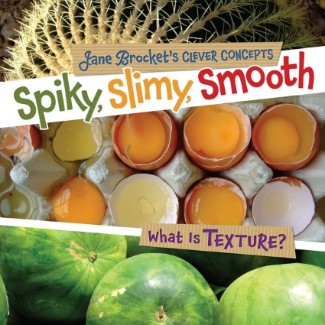
In SPIKY, SLIMY, SMOOTH (Lerner/April 1, 2011/32 pages/ages 4–8), Jane Brocket combines beautiful, bold photos of everyday objects with deliciously descriptive language.
While the reading level seems a bit too advanced for most kids who will likely be studying textures as part of their science curriculum, it will make a great read-aloud for their teachers looking for an engaging way to present the topic. Brocket’s text includes many interactive elements, and her kid-friendly photos will have young learners wiggling their toes, delving into their memory banks, and stretching their imaginations to experience the textures themselves.
Happy Nonfiction Monday! You can see the rest of the roundup over at Rasco from RIF here.
February 26th is National Fairy Tale Day!
I love fairy tales. My husband loves fairy tales (thanks to him we own an almost complete set of the Pantheon Fairy Tale and Folklore Library!). And of course, my kids love fairy tales. Who doesn’t?
![]() |
![]() |
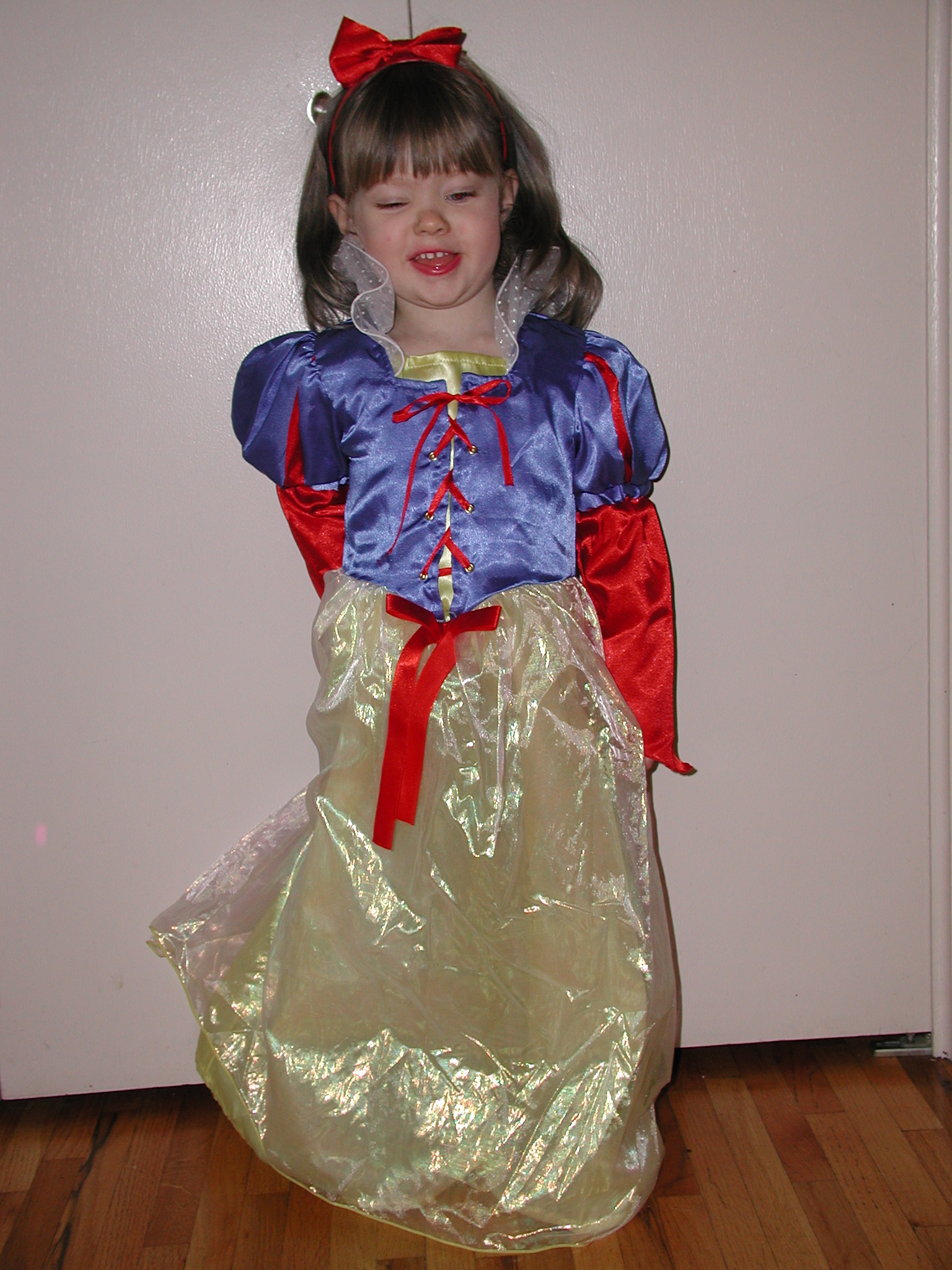
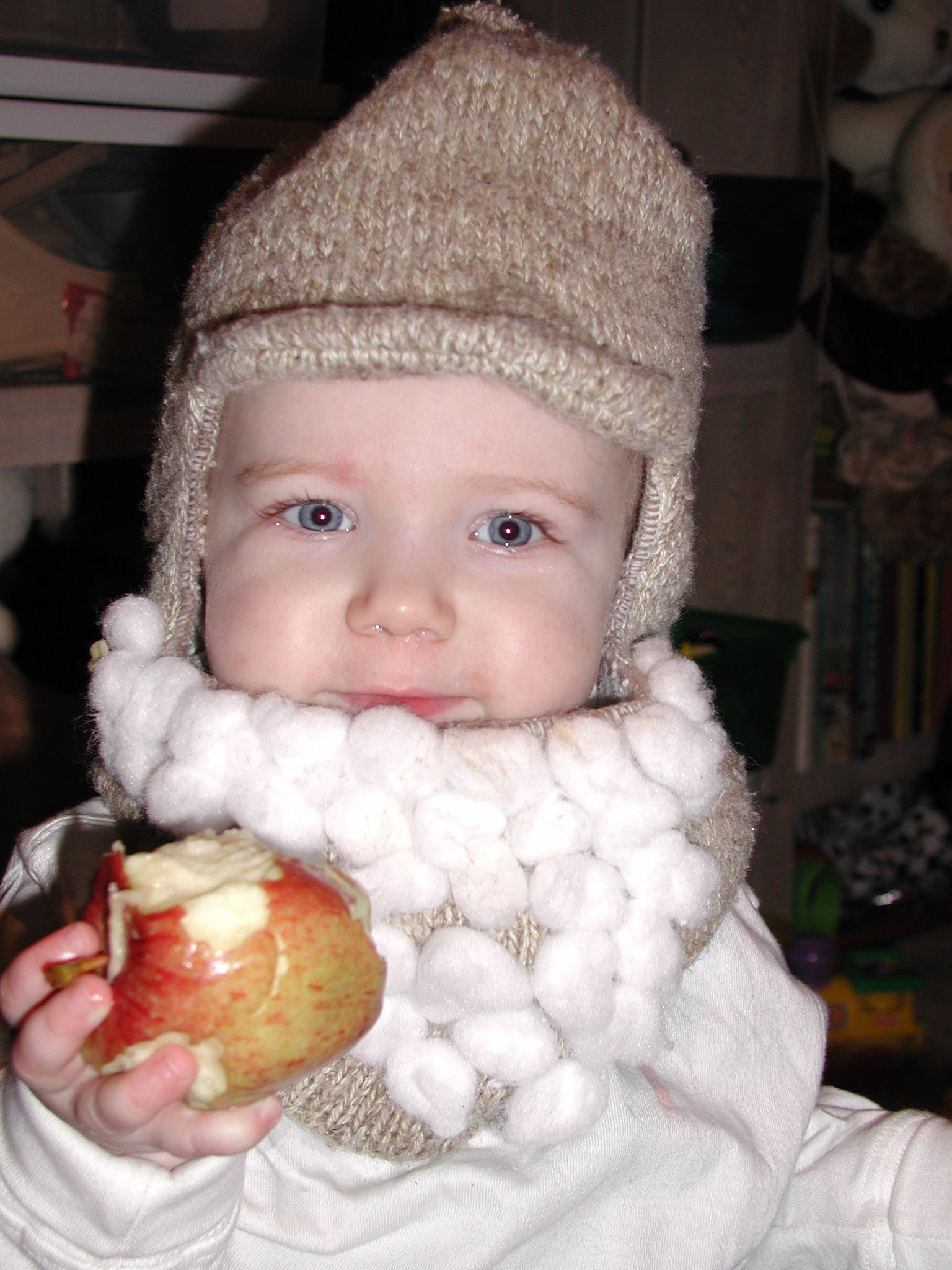
| Old photos of Snow White and one of her dwarfs—Hungry, maybe? | |
While searching for ideas for this month’s Picture Book Marathon, I’ve been reading more fairy tales and folktales than I normally do. And I’ve been loving every minute of it!
Imagine my surprise when I discovered the February 26th is National Fairy Tale Day! I can’t find an official source for that, but other people seem to celebrate it, so why not? I’ll take any excuse to share some of my newly discovered favorites with the kids at bedtime tonight, or maybe I’ll even read them some of the retellings I’ve written this month. 🙂
Looking for more fairy tale facts or fun? Here are some resources I’ve found:
- SurLaLune is THE place to start researching fairy tales on the web. It features 49 annotated fairy tales, including their histories, similar tales across cultures, modern interpretations and over 1,500 illustrations. Wow!
- Here’s a great old post written by Hannah Boyd about Why Fairy Tales Matter.
“[Fairy tales] work through so many personal and cultural anxieties, yet they do it in a safe, ‘once upon a time’ way,” says Maria Tatar, a professor at Harvard College who writes about, and teaches classes on, fairy tales. “Fairy tales have a real role in liberating the imagination of children. No matter how violent they are, the protagonist always survives.”
- There are some great resources for Teaching with Fairy Tales and a huge list of links at K‑3 Learning Pages, plus Scholastic has a Myths, Folktales & Fairy Tales Internet Project for teachers. EDSITEment has a lesson plan about comparing fairy tales from around the world, and abcteach has some free printables. Alabama learning exchange provides a lesson plan for teaching the elements of short story using Little Red Riding Hood, and EducationWorld offers one on Using Fairy Tales to Debate Ethics.
I’d rather just read and enjoy (and write!) them, though. Two of my favorites have always been The Ugly Duckling and Puss in Boots. I guess I’ve always been a sucker for a good underdog story.
What are your favorites, and why?
p.s. February is also National Love Your Library Month. Why not head to your local library and pick up some fairy tales to enjoy with someone special tonight?
Oodles of story ideas!

I’m behind on the Picture Book Marathon and have some serious catching up to do, so I’m going to make this short, but thanks to this Picture Book Marathon blog post, I discovered some great new story idea resources that I just have to share!
Author Rick Walton has some great tips for coming up with story ideas here. He lists a bunch of different ways you might get started with a story. For example, choose a character, a quest, or even just a phrase–just about anything that comes to mind–then follow it, and see where it goes.
To help with that, he’s also compiled lots and lots of amazing brainstorming lists for children’s book writers, which you can find here. A few of my favorites include:
- 457 Creatures and Things of Fantasy, Mythology, and Magic
- 651 Things Kids Do
- 470 Issues in Kids’ Lives
- 419 Common Proverbs
If you can’t find some story ideas in there somewhere, you might want to try a new career. Maybe brick laying or air traffic control? (Oh wait, that’s what MY high school aptitude test said I should do. I guess you’re on your own.)